
Question : How far do you agree with the view that the focus on lack of availability of food as the main cause of hunger takes the attention away from ineffective human development policies in India?
(2018)
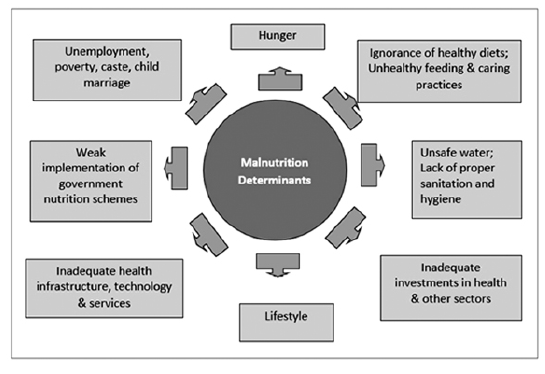
Answer : Post economic reforms of 1991, India achieved higher economic growth reaching close to double digits and even today, is fastest growing economy. However, economic growth has not resulted in elimination of hunger and malnutrition.
Today, Hunger and Malnutrition remains as a challenge in India which is reflected by
Question : Appropriate local community-level healthcare intervention is a prerequisite to achieve ‘Health for All’ in India. Explain.
(2018)
Answer : According to Article 47 of Indian Constitution, it is the duty of the State to raise the level of nutrition and the standard of living and to improve public health. To achieve this India’s flagship health sector program, the National Health Mission (NHM) was introduced.
Need for ‘Health for All’ & Government Initiatives
Question : “To ensure effective implementation of policies addressing water, sanitation and hygiene needs the identification of the beneficiary segments is to be synchronized with the anticipated outcomes.” Examine the statement in the context of the WASH scheme.
(2017)
Answer : Wash is an acronym that stands for Water Sanitation and Hygiene. This is very closely related with disease prevention and healthcare with further implications to poverty issues due to out of pocket health expenses. It has been implemented from long back but to ensure effective implementation, identification of beneficiary and linkage of it to outcomes is essential.
What was found in recent studies on sanitation
Question : Does the Rights of Persons with Disabilities Act, 2016 ensure effective mechanism for empowerment and inclusion of the intended beneficiaries in the society?
(2017)
Answer : The new Act expands and extents the benefits for the inclusion of newer category of disables. But, to ensure effective mechanism for empowerment requires more than legal provisions.
The Rights of Persons with Disabilities Act, 2016 is much improved and progressive version of the earlier Act of 1995. This Act brings the law in line with the UN Convention on Rights of Persons with Disabilities.
Salient Features:
Question : Hunger and poverty are the biggest challenges for good governance in India still today. Evaluate how far successive governments have progressed in dealing with these humongous problems. Suggest measures for improvement.
(2017)
Answer : On the eve of Independence, Indian economy was in a very bad shape due to the presence of British colonial rule. The Britishers generally framed policies that favoured them. The only purpose of Britishers was to unjustly enrich themselves at the cost of India’s economic development. Thus, in 1947, when British transferred power back to India, we inherited a crippled economoy and widespread poverty.
But, India did not have enough resources at its disposal. This explains ....
Question : Is the National Commission for Women able to strategize and tackle the problems that women face at both public and private spheres? Give reasons in support of your answer.
(2017)
Answer : Greatness of any civilisation lies in how it treats women. National Commission of Women as a statutory body was created in 1992 under the National Commission for Women Act 1990 to protect the Constitutional and Legal Rights of women in India. To answer whether the body is able to tackle the problems of women one needs to see the effectiveness and limitation of the body.
Problems Faced by Women:
Question : “The emergence of the Self-Help Groups (SHGs) in contemporary times points to the slow but steady withdrawal of the State from developmental activities.” Examine the role of the SHGs in developmental activities and the measures taken by the Government of India to promote the SHGs.
(2017)
Answer : Self Help Groups (SHGs) have become a very effective concept to develop and empower poor. These are small groups formed to serve different interests of group members, especially their credit needs.
Role of SHGs in Developmental Activities
SHGs play very important role in the empowerment of women, poor and other socially and economically disadvantaged groups. SHG, as a concept, has become a revolution. Various roles played by SHGs are:
Question : “Poverty alleviation programmes in India remain mere showpieces until and unless they are backed up by political will.” Discuss with reference to the performance of the major poverty alleviation programmes in India.
(2017)
Answer : The poverty alleviation programmes in India are generally classified into (i) Self employment programmes; (ii) wage employment programmes; (iii) food security programmes; (iv) social security programmes; and (v) urban poverty alleviation programmes.
Some of the major poverty alleviation programmes started by the Government in the last 15 years include: a rural connectivity scheme (PMGSY), a universal primary schooling initiative (SSA), a rural health initiative (NRHM), a rural electrification scheme (RGGVY), a rural employment guarantee (NREGA), a ....
Question : In the integrity index of Transparency International, India stands very low. Discuss briefly the legal, political, economic, social and cultural factors that have caused the decline of public morality in India.
(2016)
Answer : Transparency International (TI) is a Berlin based anti-corruption watchdog which publishes corruption perception Index annually. India ranked 76 out of 168 countries showing no improvement with respect to last year score. This implies a decline in public morality in India.
The various factors responsible for this decline involve:
1. Legal factor:
Question : “Demographic Dividend in India will remain only theoretical unless our manpower becomes more educated, aware, skilled and creative.” What measures have been taken by the government to enhance the capacity of our population to be more productive and empolyable?
(2016)
Answer : Demographic dividend as defined by the united Nations population fund (UNPF) Means, the economic growth potential that can result from shift in a population’s age structure mainly when the score of the working age population (15 to 64) is larger than the non-working age score of the population. By 2021, 67 percent of India’s population will be under working age (Economic Survey-12)
However this may not be realized automatically but depends upon a right economic policy ....
Question : Examine the main provisions of the National Child policy and throw light on the status of its implementation.
(2016)
Answer : In pursuance of the constitutional objective and UN convention on child rights, the government launched National Child Policy in 2013 reaffirming children as an important national asset. Through right based approach policy proposes to provide long term, sustainable, multi-sectoral, integrated and inclusive approach for the overall and harmonious development and protection of children.
Various provisions and their implementation
1. Survival Health and Nutrition
Question : Professor Amartya Sen has advocated important reforms in the realms of primary education and primary health care. What are your suggestions to improve their status and performance?
(2016)
Answer : Considering the poor quality of primary education as reflected in ASER report and high out of pocket expenditure (about 70 percent) India needs to broaden its base in the spheres of education & healthcare to foster economic growth said Noble laureate Amatya sen. Further low coverage and low quality of scheme education in India extracts a heavy price in the pattern of our economic development.
Amatya Sen says India remarks alongside Haiti and Sierra leone when ....
Question : The Self-Help Group (SHG) Bank Linkage Programme (SBLP), which is India’s own innovation, has proved to be one of the most effective poverty alleviation and women empowerment programmes. Elucidate.
(2015)
Answer : The Self help bank linkage programme launched by NABARD way back in 1992 envisaged synthesis of formal financial system and informal sector has become a movement throughout a country. A major objective of the SBLP is to alleviate poverty by extending banking services to the poor, thereby helping them to enhance employment and income opportunities to come out of poverty. It has its impact on poverty alleviation and women empowerment through group effort and ensuing ....
Question : How can the role of NGOs be strengthened in India for development works relating to protection of the environment? Discuss throwing light on the major constraints.
(2015)
Answer : NGO plays a very important role in protection of environment through social services. Some of the NGOs working in this field in India are AWAAZ Foundation, Goa Foundation, CONSERVE India, Kalpavriksha, WWF India. They spread the awareness amongst the public to conserve and protect wildlife, forests etc. The key constraints that hinders their work towards environment protection are delayed registration process and inadequate availability of funds for their unrestrained working.
Further, these NGO’s do not have ....
Question : Public health system has limitations in providing universal health coverage. Do you think that the private sector could help in bridging the gap? What other viable alternatives would you suggest?
(2015)
Answer : Large population combined with low incomes levels, high incidence of diseases, and the dire need to have a healthy population working at their maximum potential to ensure economic growth. All these make it imperative to have Universal health coverage.India’s health system is largely dominated by public sector especially in rural areas. Participation of private sector is by far mostly restricted to urban areas. But, India’ public health care system, despite serving as a bedrock of ....
Question : Though there have been several different estimates of poverty in India, all indicate reduction in poverty levels over time. Do you agree? Critically examine with reference to urban and rural poverty indicators.
(2015)
Answer : The UNDP MDG 2014 report says India is home to the largest number of poor with one-third of the world’s 1.2 billion extreme poor living here. According to HDR 2015 Multidimensional Poverty Index (MPI), 55.3 percent of Indian population is multi-dimensionally poor. The MPI, which is the share of the population that is multi-dimensionally poor, adjusted by the intensity of the deprivations, is 0.282. Bangladesh and Pakistan have MPIs of 0.237 and 0.237 respectively. The ....
Question : Do government’s scheme for up-lifting vulnerable and backward communities by protecting required social resources for them, lead to their exclusion in establishing business in urban economies?
(2014)
Answer : Government has initiated various schemes to uplift the vulnerable (women, children, person with disability, poor migrants) and backward communities (SC, ST, Dalits, Tribes) is affecting the establishment of business in one way or the other in urban economies.
To establish a business there is need of capital, labour etc. and above all there is need of risk taking attitude to run a successful business. The government schemes though necessary, develops a dependent attitude among the vulnerable ....
Question : Should the premier institutes like IITs/IIMs be allowed to retain premier status, allowed more academic independence in designing courses and also decide mode/criteria of selection of students. Discuss in light of the growing challenges.
(2014)
Answer : The QS World University Rankings, an annual listing of the world’s top universities, had no Indian institutes in the top 200 of its global list for 2013. Also, India has one of the poorest Gross Enrolment Ratios (GER) for higher education in the world, which raise debate on quality and standard of Indian top universities like IITs and IIMs, whether they deserve the premier status enjoyed by them along with this can these institutes be ....
Question : An athlete participates in Olympics for personal triumph and nation’s glory; victors are showered with cash incentives by various agencies, on their return. Discuss the merit of state sponsored talent hunt and its cultivation as against the rationale of a reward mechanism as encouragement.
(2014)
Answer : “The more you sweat in peace, the less you bleed in war” is a saying but for Indian athlete reverse is happening. One who puts all its efforts for winning a medal in Olympic or other international sports event, encouragement comes in the name of sponsorship but no one comes before to sponsoring during his practice session and training by providing necessary equipments. Under this situation, the question arises why not state sponsor the talented ....
Question : The penetration of Self Help Groups (SHGs) in rural areas in promoting participation in development programmes is facing Socio-cultural hurdles. Examine
(2014)
Answer : Self Help Groups (SHG) is a small voluntary association of poor people preferably from the same socio-economic back ground. The micro credit given to them makes them economically empowered. It can be all women group, all men group or even mixed group. However, it has been experience that women’s group perform better in all important activities.
SHG plays an important role in rural economy and especially women groups contribute for rural development in their communities. Hence, ....
Question : The concept of Mid-Day Meal (MDM) scheme is almost a century old in India with early beginnings in Madras Presidency in pre-independent India. The scheme has again been given impetus in most states in the last two decades. Critically examine its twin objectives, latest mandates and success.
(2013)
Answer : Mid-day meals in India’s government schools were envisaged to stop hunger from keeping children away from schools and to improve enrollment.
MDMS has boosted school attendance, especially of girls, and has in some cases even reduced nutritional deficiencies in children.
Despite the success of the programme, child hunger as a problem persists in India. According to current statistics, 42.5% of the children under 5 are underweight. Various scams involving Mid-day Meal Scheme have been unearthed since it ....
Question : The legitimacy and accountability of Self Help Groups (SHGs) and their patrons, the micro-finance outfits, need systematic assessment and scrutiny for the sustained success of the concept. Discuss.
(2013)
Answer : Self-Help Groups have been a phenomenal story of success, providing banking needs to the poor and the destitute. However, the legitimacy and accountability of SHGs and their patrons are plagued with lot of problems, among which are multiple lending, over borrowing, ghost borrowers and coercive method of recovery. It was these problems which were identified by Y.H. Malegam committee. The committee has made a number of recommendations to mitigate the problems. They include:
Question : The basis of providing urban amenities in rural areas (PURA) is rooted in establishing connectivity. Comment.
(2013)
Answer : Provision of Urban Amenities to Rural Areas (PURA) is a strategy for rural development in India. This concept was given by former president Dr. A.P.J. Abdul Kalam. PURA proposes that urban infrastructure and services be provided in rural hubs to create economic opportunities outside of cities. Physical connectivity by providing roads, electronic connectivity by providing communication network, and knowledge connectivity by establishing professional and Technical institutions will have to be done in an integrated way ....
Question : Identify the Millennium Development Goals (MDGs) that are related to health. Discuss the success of the actions taken by the Government for achieving the same.
(2013)
Answer : Targets set up by the UN:
India was estimated to have an adult (15-49 years) HIV prevalence of 0.27% in 2011. Adult HIV prevalence among males and females was estimated at 0.32% and 0.22% respectively. Due to constant effort of the Health ....
Question : Keeping in view the informal sector's share in the total workforce of the country, critically examine the relevant inclusive measures initiated by the Government of India and their effectiveness.
(2012)
Answer : Unorganised or informal sector constitutes a pivotal part of the Indian economy. More than 90 per cent of workforce and about 50 per cent of the national product are accounted for by the informal economy. A high proportion of socially and economically underprivileged sections of society are concentrated in the informal economic activities. The high levels of growth of the Indian economy during the past two decade are accompanied by increasing informalisation. There are indications ....
Question : The Union Cabinet recently cleared the proposal to rename and amend the Child Labour (Prohibition and Regulation) Act, 1986. What are the salient features of the proposed amendments?
(2012)
Answer : The National Advisory Committee recently constituted a working group under the leadership of Mr. Harsh Mander to propose amendments to Child Labour (Prohibition & Regulation) Act, 1986. The report was recently approved by the cabinet. Following are the salient features of the proposed amendments:
Employing a child below 14 years in any kind of occupation (Hazardous or non hazardous) will be completely banned. The punishment prescribed for the same is jail with a maximum three years ....
Question : What are the salient features of the Consumer Protection (Amendment) Bill, 2011 introduced in the Lok Sabha in December 2011?
(2012)
Answer : The Consumer Protection (Amendment) Bill, 2011 was introduced in the Lok Sabha in December 2011 by Mr. K.V. Thomas with the aim to empower the consumers to protect themselves against unfair practices of manufactures and providers of services. It has been referred to the Standing Committee on Food, Consumer Affairs and Public Distribution. The salient features of the bill are:
The bill seeks to widen the scope of the law by adding some new definitions and ....
Question : Comment on the recent launching of the National Mission on Libraries (NML).
(2012)
Answer : The National Mission on Libraries was set up as a high level committee upon the recommendations of National Knowledge Commission to improve the library sector in India. It aims to link up around 9,000 libraries digitally across India and upgrade the exiting public libraries, set up community information centers school and college libraries. This will help those in towns and villages to access books and information from across the world. Thus it reduces the access ....
Question : Discuss the extent, causes and implications of the nutrition transition said to be underway in India.
(2011)
Answer : Nutrition research in India has previously focused on the serious problem of under nutrition related to nutrient deficit and high rates of infection particularly among vulnerable women and children. The increased consumption of unhealthy foods compared with increased prevalence of overweight in middle-to-low income countries is the case of nutrition transition. Food rich in vitamins, minerals and micronutrients such as fruits, vegetables and whole grains have been substituted by foods heavy in added sugar, saturated ....
Question : Bring out the salient features of PCPNDT Act. 1994 and the implications of its amendment in 2003.
(2011)
Answer : The phenomenon of the 'missing girl' has become an all-India phenomenon and cut across each strata of the Indian society. The child sex ratio used to capture the 'missing girl' phenomenon since 1991 has shown a considerable downward trend. In 2001 though the sex ratio showed an increase, but child sex ratio declined to 927. (Census 2001) This decline was despite the enactment of PCPNDT Act, 1994 indicating its ineffectiveness and faulty implementation. The salient ....
Question : Critically examine the design of the National Rural Livelihood Mission (NRLM) scheme. Do you think it has a better chance of success than the Swarnajayanti Gram Swarozgar Yojana (SGSY) in achieving its objective?
(2011)
Answer : NRLM was announced in the Budget 2009-10 to replace the SGSY. It seeks to alleviate rural poverty by 2015 by redesigning the SGSY. While the NRLM promises a lot with regard to creation and strengthening of rural livelihoods, it does suffer some serious shortcomings, which if not addressed are likely to see it move in the same path as the IRDP, SGSY and/or other programs. The criticisms are as follows:
Question : Deendayal Disabled Rehabilitation Scheme (DDRS)
(2011)
Answer : The umbrella Central Sector Scheme called the "Scheme to Promote Voluntary Action for Persons with Disabilities" was revised with effect from 01.04.2003 and was renamed as the "Deendayal Disabled Rehabilitation Scheme (DDRS)". Under the scheme, funds for the welfare of persons with disabilities are provided to the non-governmental organizations for projects like special schools for disabled, Vocational Training Centres, Half Way Homes, Community Based Rehabilitation Centres, Early Intervention Centres for Disabled and Rehabilitation of Leprosy ....
Question : ‘Swavalamban’ Scheme
(2010)
Answer : Swavalamban Scheme, launched in Sep 2010, is applicable to all citizens in the unorganized sector who join the New Pension System. Under the scheme, Government will contribute Rs. 1000 per year to each NPS account opened in the year 2010-11 for the next three ....
Question : National Investment Fund
(2010)
Answer : National investment fund, launched in 2007, is a fund maintained outside the consolidated fund of India to which all proceeds from central public sector enterprise disinvestment will be routed. Out of the entire yearly corpus, 75% will be utilized to finance social sector strategies and remaining 25% will be expended to meet up the capital investment needs of profitable and revivable ....
Question : “Small holder farms need to be strengthened to achieve national food security.” Do you agree with this assessment? Substantiate.
(2010)
Answer : Small holder farmers could be defined as those marginal and submarginal farm households that own or/and cultivate less than 2.0 hectares of land. The strengthening of small holder farms is important because of two reasons. One, as per agricultural census (1990-91) 33% of the total cultivated land in India is small farms and it contributes 41% of the national grain production. Secondly small holder families constitute more than half of the national population and this ....
Question : Critically examine the differing estimates for (i) poverty figures and (ii) GDP growth data for April-June 2010, that have been in the news recently. In your view, what estimates are more reflective of the ground reality, and why?
(2010)
Answer : Nothing is easier than to recognise a poor person when you see him or her. Yet the task of identifying and counting the poor seems to elude the country’s best experts. In India poverty figures that is captured by BPL families/households has similar variable data. Four alternative figures are available: 28 per cent from the Planning Commission, 50 per cent from the N.C. Saxena Committee report, 42 per cent from the Tendulkar Committee report, and ....
Question : Distinguish between the objectives, structure and functioning of the ‘Kendriya Vidyalaya Sangathan’ and the ‘Navodaya Vidyalaya Samiti’.
(2010)
Answer : The Kendirya Vidyalaya Sangathan is registered as a society under the Societies Registration Act (XXI of 1860). The primary aim of the Sangathan is to provide, establish, endow, maintain control and manage the Central Schools (Kendriya Vidyalayas) located all over India and abroad. The Sangathan has three tier management structure with its (I) Headquarters (II) Regional Offices managing a cluster about 45-50 schools and (III) Kendriya Vidyalayas spread all over the country and abroad each ....
Question : Comment on the salient features of the recent draft Model Real Estate (Regulation of Development) Act of the Ministry of Housing and Urban Poverty Alleviation of the Central Government.
(2010)
Answer : In order to promote planned and healthy real estate development of colonies and apartments with a view to protecting consumer interest on the one hand and to facilitate smooth and speedy urban construction on the other; Ministry of Housing & Urban Poverty Alleviation has drafted a draft Model Real Estate (Regulation of Development) Act.
The bill seeks to establish a regulatory authority and an appellate tribunal which will help to regulate, control and promote planned and ....
Question : What are your views on the features and impact of Domestic Violence Act, 2005?
(2009)
Answer : The hallmark of any matured and civilized society is gender justice. In this context Domestic violence Act, 2005 has enlarged the sphere of protection given to women in their domestic relationship. The main features of this Act makes for penal provision for all the acts of commonly understood violence within the four confines of the home. The act covers even verbal abuse and threat under the definition of violence, so physical and actual violence is ....
Question : Mushrooming of Higher Educational Institutions was a matter of grave concern for Yashpal Committee. With reference to the relevant portion of that report give your views how to harmonise private investment and quality of education.
(2009)
Answer : "Deemed universities have become doomed universities" said the Yashpal Committee on the occasion of presenting its report on the 'mushrooming of higher educational institutions' in the country. Now education has been monetized completely. In this whole context with a multiplicity of regulators and the private education lobby emerging very powerful quality is the biggest casualty. In the present scenario when there is talk of increased interface between the industrial houses and the educational institutions and ....
Question : The Last National Family Health Survey (NFHS) displayed a very dismal picture of nutrition as regards several indicators for average Indians. Highlight the salient aspects of this problem.
(2009)
Answer : The third NFHS presented a holistic picture of the national nutrition of the Indian populace. The report says that more than three-quarter of the Indian females are severely anemic. The report further says that in every five children born, two have less than 10% chances of survival. India has the largest number of malnourished children in the whole world that is roughly touching the figure of about 115 million. The report further says that though ....
Question : 'As we live in a plural society we need the greatest freedom to express our opinions even if others find it offensive' - Do you agree? Discuss with reference to some recent incidents in the Indian context.
(2009)
Answer : In the recently released books of certain national level politician who have carved out niche power to sway public perception to certain extent, had certain judgemental statements. Resultantly, this created a ruckus in the political arena. India is certainly a plural society- a cauldron of different cultures which certainly deciphers the historical facts in their own colors of perception. In this regard the people who are in a sort of leadership arena should be more ....
Question : Examine whether rural women in India have been empowered by their active participation in Panchayat Raj System.
(2008)
Answer : Dramatic changes have taken place in the legal, political, educational and social status of women since independence.
Indian constitution promised a complete equality to women, women got a voting power along with men. But still there was no adequate participation by women in Indian political system.
73rd and 74th Amendment Act of 1992 bought a tremendous change in the participation of women in political system. According to these amendment women are given one third reservation in Panchayat ....
Question : “Decline in the sex ratio in India is an alarming sign for India’s future social development.” Discuss.
(2008)
Answer : According to government reports 2 million fact uses are aborted each year for reason none other than they happen to be females.
Census 2001 shows that during the 1991-2001 decade the overall sex ratio increased from 927 per 1,000 to 933 per 1,000. But during the same decade the child sex ratio (0-6 years) dropped from 945 to 927, while the sex ratio in the 7+age group increased from 923 to 935.
The problem of declining sex ....
Question : Universal Declaration of Human Rights
(2008)
Answer : On December 10, 1948 the General Assembly of the United Nations adopted and proclaimed the Universal Declaration of Human Rights.
The declaration arose directly from the experience of the second world war and represents the first global expression of rights to which all human beings are inherently entitled. If consists of 30 articles which have been elaborated in subsequent international treaties, regional human rights instruments, national constitutions and laws.
The international Bill of Human Rights consists of ....
Question : Impact of globalization on state system and its institutions.
(2007)
Answer : The impact of globalisation is being visible in almost all sectors, infact the state system is also not untouched. Openness is obvious in economic, social and cultural sectors under globalisation. At present no country can even think of development, keeping itself aloof from the globalisation process. Naturally in such a scenario, change in the state system has become very important. It is a result of globalisation that now-a-days the democratic system hasbecome stronger in comparison ....
Question : Bring out the main objectives of Rashtriya Krishi Bima Yojana. The scheme is being implemented by which agency?
(2007)
Answer : In 1999-2000 the Rashtriya Krishi Bima Yojana was started by establishing extensive successful Bima Yojana. The main objectives of the Rashtriya Krishi Bima Yojana are as follows –
Question : The Lokpal Bill
(2007)
Answer : The most criticised and proposed bill to Parliament, Lokpal Bill has the following aims–
Question : Integrated Child Development Services (ICDS).
(2007)
Answer : Integrated Child Development Services (ICDS) aims are:
Under ICDS nutritious food, health and education related facilities are provided to children and pregnant women. Under ICDS almost ....
Question : What is the problem related to rehabilitation of the mentally challenged persons in India?
(2006)
Answer : It is unfortunate that even after almost sixty years of independence, besides having a National Mental Health programme, we don’t have country wide epidemiological data of mental illness and whatever available are only estimates and those estimates are based on the prevalence and incidence of other countries. Reducing the incidence of mental disorder by developing programs to forestall emotional problems and produce wellness is referred to a primary responding to sight of illness, primary prevention ....
Question : Explain the implications of the recent Supreme Court verdict on reservations in private and minority educational institutions.
(2005)
Answer : In a landmark judgment on April 12, 2012, the Supreme Court upheld the constitutional validity of the provision in the Right to Education Act, 2009 that makes it mandatory for all schools (government and private) except private, unaided minority schools to reserve 25% of their seats for children belonging to “weaker section and disadvantaged group”.
The Act provides that children between the ages of six and 14 years have the right to free and compulsory education ....
Question : What is PURA? Discuss its major objections.
(2004)
Answer : PURA stands for Providing Urban Amenities in Rural Areas to tackle the problem of migration of people from rural to urban areas for employment. President APJ Abdul Kalam has proposed the concept of PURA in the VISION 2020 project initiated by him. Its objective is to make rural areas as attractive to inverter as cities are. Then, rural areas too will generate urban-style employment to halt, if not reverse, rural urban migration. Its major objectives ....
Question : Explain UNDP Report on human development in India.
(2004)
Answer : India maintained its 127th in the human development index rankings released by the UNDP-in the Human development Report, 2004. As per the HDR, India’s life expectancy at birth in the year 2002, the latest available, was 63.7 years, adult literacy rate (percentages 15 and above) was 61.3, combined gross enrolment ratio for primary, secondary and tertiary schools was 55 per cent and GDP per capita (purchasing power parity basis) was 2670 dollars.
According to the report, ....
Question : How is poverty level measured? Evaluate poverty eradication programmes in India.
(2004)
Answer : Calorie consumption expenditure level is an important method to determine poverty line in India. Per capita daily calorific minimum has been defined as 2,400 calories villages and 2,100 calories in cities. If we consider this on the basis of sex, a very rough average for the required intake is 3,900 for working women. Though this method appears to be a foolproof method, there are some built in glitches. Since this particular measures of poverty is ....
Question : Suggest measures for the eradication of wide spread corruption in public life in India.
(2003)
Answer : Corruption in India is a consequence of the nexus between Bureaucracy, politics and criminals. One part of the remedy is to limit the role of ministers to evolve policies and leave the application of policies to individual cases in the hands of an independent commission/authority in each such area of public interest. Each such commission/authority may be a statutory body whose members are ‘appointed by the cabinet on the basis of their professional credentials for ....
Question : Identify the types of disabilities.
(2003)
Answer : Disabilities are of two broad types: physical and mental. The physically disabled include the deaf, dumb, blind and orthopedics. Mental disability includes mental retardation, autism and cerebral palsy. A disability becomes a handicap when it interferes with one’s ability to do what is expected at a particular time.
The persons with Disability: Equal Opportunities, Protection of Rights and Full Participation Act, 1995 includes the following types of disability — blindness, low vision, leprosy-cured, hearing impairment, locomotors ....
Question : Discuss the role of the United Nations in the protection and promotion of Human Rights.
(2003)
Answer : The UN adopted the declaration in December 1948, proclaiming it as a common standard of achievement for all people and all nationals. According to it, everyone has the right to life, liberty and security of person; no one shall be held in slavery: no one shall be arbitrarity arrested, there shall be equality before law; freedom of movement shall be guaranteed and right of association and social security shall be recognised. It is a statement ....
Question : Outline the salient features of India’s nuclear policy and explain the reasons for India’s refusal to sign the CTBT.
(2003)
Answer : India’s nuclear doctrine is unique. Firstly, it is a consensus document designed for public debate unlike the nuclear doctrine of most countries, which are kept secret. Secondly, it adheres firmly to its continued commitment to nuclear disarmament, which it lays down as one of the country’s national security objectives. The doctrine, which has been formulated by the National Security Advisory Board, is still in draft form as it has yet to be discussed in Parliament. ....
Question : Write briefly about the programmes for ‘welfare of the disable’.
(2002)
Answer : Though it is a state subject, all policy initiatives are taken by ministry of welfare keeping in mind views of various departments/ministries of the government as well as non-governmental organisation. Close liaison is maintained with associated ministries such as the Ministry of Health and Family Welfare, the Department of Education, the Department of women and Child Development, Ministry of Personnel and Training.
The persons with disabilities Act. 1995 deals with both prevention and promotional aspects of ....
Question : What is the incidence of poverty in India? How should poverty alleviation programmes be constructed?
(2001)
Answer : There has been a sharp decline in poverty over the last five years with the percentage of population Below Poverty Line (BPL) declining to 26.1 percent in 1999-2000 from 35.97 percent in 1993-94. According to the latest estimates of the planning commission, while the percentage of rural BPL population has dropped to 27.09 percent from 37.27, in urban India, it fell to 23.62 percent from 32.36 percent during the five year period. In absolute term ....
Question : Discuss the provision of Human Rights protection Act (1993) relating to the following
(2000)
Answer : (i) Definition of Human Rights: The Vienna Declaration and Programme of Action focus on massive violations of human rights, especially genocide, ethnic, cleansing and systematic rape, on self-determination, referring for the first time to “a government representing the whole people belonging to a territory without distinction of any kind,” on the environmental needs of present and future generations.
(ii) Composition of the National Human Rights commission: National Human Rights commission was constituted in October 1993 under ....
Question : What suggestions have been made for amending the Act for making the role of the NHRC more effective?
(2000)
Answer : In order to make the NHRC more effective and keeping in mind the country’s obligation under international conventions, the Government has been sending information and replies to specific questions received from various Rapporteur of the UN High Commission for Human Rights. Prompt replies sent to allegations of alleged human rights violations has strengthened the position of the Government and countered the biased propaganda launched by vested ....
Question : Discuss the proposition laid down by the Supreme Court of India in the context of Torture in prisons and Human Dignity.
(2000)
Answer : The Supreme Court has from time to time, held, that even prisoners have rights to be treated with human dignity. They are not to be treated with derogatory manner and inhuman torture. The court has widened the scope of Article 21 to provide free legal aid and speedy trial as fundamental right. Even the Supreme Court has held that solitary confinement should not be imposed except on extra ordinary courses. It was held to be ....
Question : What is the rational for ‘Mid-day Meal’ Scheme?
(2000)
Answer : This scheme is launched to serve the people who are living below poverty line, thus can provide them with nutrition’s food apart from imparting basic education by attracting them to ....
Question : Universal Postal Bill
(2000)
Answer : It came into existence in 1875. The universal postal convention was adopted by the postal congress of Berne on 9th October, 1874; it became the base for the Universal Postal Union.
The Union Postal Bill aims at –
It is a specialized agency of the UN Since 1948. Its constitution ....
Question : Economic and Social Council.
(2000)
Answer : The economic and social council was set up by the UN charter as the principal organ to co-ordinate the functions of the UN, Specialized Agencies and institutions with regard to international economic, social, cultural, educational, health and related matters. It operates under the authority and supervision of the General Assembly and is responsible to it. ECOSOC is committed to establish world peace by creating conditions of stability and well-being required for peaceful and friendly relations ....