
Question : Define fecundity and explain major factors affecting fecundity in Indian populations.
(2018)
Answer : Fecundity is the potential to reproduce-how much a single person can reproduce i.e., how many children a single woman can give birth to. Fertility rate describes offspring per couple, individual or a population whereas fecundity refers to natural ability to reproduce. Fertility is a way through which human beings biologically replace themselves in order to continue their existence on earth.
Fertility refers to the natural capacity to produce offspring. Fertility as a measure (fertility rate) refers ....
Question : Describe the biological and socio-ecological factors affecting fertility and mortality.
(2017)
Answer : Fertility
Fertility is defined as the natural capacity to produce offspring. Fertility is measured at the rate of offspring per couple or average birth per female in the population (total fertility rate). Any society replenishes itself through the process of human fertility. Thus, in population dynamics, fertility is a positive force through which the population expands, counteracting the force of attrition caused by mortality. If this replacement of human numbers is not adequate, that is, if ....
Question : Age at menarche.
(2017)
Answer : Menarche is the culmination of a series of physiological and anatomic process of puberty. During this period, a number of physiological changes occur in the girl’s body wherein secondary sexual characters appear. Menarche i.e., first menstruation or onset of menstruation is an important event in the physical development of female life, representing significant changes in her body like onset of fecundity (under normal circumstances) with initiation of maturation of reproductive organs and development of secondary ....
Question : Menopause and its impact.
(2015)
Answer : Anthropology is the study of human culture and human biology, past and present. The discipline of anthropology is particularly well suited for the study of menopause. There is variation in age at menopause across populations, in symptom experience, and in the meaning of menopause across cultures. Among hominin ancestors, the capacity for universal female menopause and long post-reproductive life is probably a million years old. In all places and for a very long time, menopause ....
Question : Discuss the relevance as menarche, menopause and other bio-events to fertility.
(2014)
Answer : Fertility can be described as the phenomenon of childbearing. Both biological and non-biological factors play an important role in determining fertility. At the same time we can put stress on two important terms mainly involved in the reproductive process, i.e., menarche and menopause.
Two of the biggest physical milestones in a woman’s life are menarche, the first menstrual period in girls, and menopause, when menstruation stops and female reproductive hormones slow. These milestones are universal and ....
Question : Fertility and Fecundity.
(2013)
Answer : Fertility and Fecundity are closely related terms in reproductive biology. Fertility is simply a description of whether or not individual animals are able to reproduce. An organism can produce many gametes ready for fertilization, but may never get the chance to reproduce. This organism would be fertile, but would show no fecundity. As a measure, fertility rate is the number of offspring born per mating pair, individual or population. Fertility refers to the natural capacity ....
Question : Demographic Transition.
(2013)
Answer : Anthropological demography is a specialty within demography which uses anthropological theory and methods to provide a better understanding of demographic phenomena in current and past populations. Its genesis and ongoing growth lie at the intersection between demography and socio-cultural anthropology and with their efforts to understand population processes, mainly fertility, migration, and mortality.
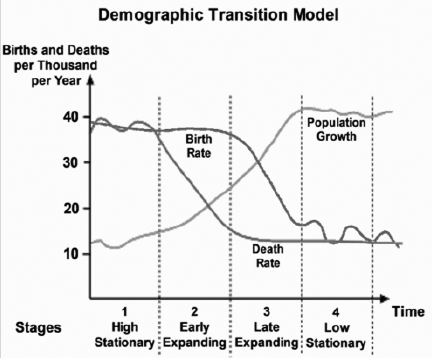
To understand the variety of demographic regimes found across the world, ....