
Question : Kinship Terminology.
(2018)
Answer : The character and quality of social relations based on kinship, marriage and family are of paramount importance in all societies. The primary reason for this is that kinship, marriage and family play a dominant role in social systems.
Kinship refers to human relationships by blood or consanguinity and affinity with relations brought by marriage. Kinship relations are actually or fictitiously traced through parent-child or sibling relations, and recognised for social purposes.
The first unit delves into the ....
Question : Define ethnography and present a brief history of ethnographic studies.
(2018)
Answer : Ethnography is about discovering human meaning and stories. It is a flexible and dynamic research methodology that uncovers meaning by fully taking on the perspectives of people through observations, interactions and conversations in their natural settings.
Unlike traditional research methods like surveys and focus groups that seek confirmation of a preconceived hypothesis, ethnography explores the boundaries of what you know (and do not) and can be complementary to these traditional methods.
Ethnography is the recording and analysis ....
Question : Discuss the development of the concept of culture in Anthropology.
(2017)
Answer : Culture is the vital interest of anthropology, with important role not just in socio-cultural anthropology but also in other major sub-divisions of anthropology.
In words of E.B. Tylor, culture can be defined as “a complex whole which includes knowledge, belief, art, moral, law, custom and any other capabilities acquired by man as a member of the society”.
Culture had been defined by Tylor as knowledge, beliefs, and customs, but a society is more than just shared ideas ....
Question : Discuss the different forms of preferential marriage with suitable examples from tribal societies in India.
(2017)
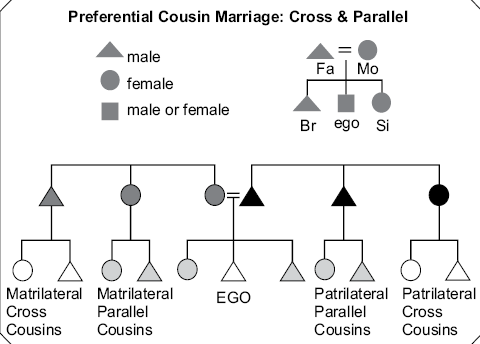
Answer : Preferential marriage, as is clear by the title, is the marriage custom in which some males or females are preferred for establishing matrimonial relationships. In such cases, the marriage is a means for uniting two families, for welfare of both. Such marriages are common in South Indians (Cross-cousins) and among Muslims (Parallel cousins). The preference is clearly based upon certain advantages concerning new relationship and adjustment and respect in the new family.
Question : Elucidate the determinants of Kinship terminology.
(2017)
Answer : Kinship terminology refers to the terms that systematically designate distinctions between the relatives of different categories and organize them into social groupings, categories and genealogies.
The terminological aspect of the kinship system is as important as the behavioural aspect. The kinship terms are the positive determinants of the social facts of life and relationships and therefore quite important for the study of society. Radcliff-Brown felt very much the importance of the terminological aspect of kinship. He ....
Question : Bilineal and bilateral descents.
(2017)
Answer : Descent refers to a person’s affiliation and association with his/her kinsman. In a patrilineal society a person traces his descent through father while in a matrilineal society descent is traced through the mother. Descent Group comprises of people having a common ancestor, the common ancestor can either be a living, non-living or mythical being like an animal, tree, human being, thunder, etc. Rules of descent can be divided into two distinct types:
Question : Short notes on cultural relativism.
(2016)
Answer : Cultural relativism is the ability to understand a culture on its own terms and not to make judgments using the standards of one’s own culture. The goal of this is to promote understanding of cultural practices that are not typically part of one’s own culture.
Using the perspective of cultural relativism leads to the view that no one culture is superior than another culture when compared to systems of morality, law, politics, etc. Cultural relativism is ....
Question : Discuss the impact of urbanization and feminist movements on family in India.
(2016)
Answer : Family, defined as a group entity where individuals are born and taken care of, provides the bases for socialization and learning of the individuals. In recent past family setup has seen significant changes due to a range of new developments like capitalism, industrialization, urbanization, medical advances and other social changes.
Impact of Urbanization on Family
The major changes in the family due to the rise of urbanization are:
Question : Lineage and Clan.
(2016)
Answer : Lineage
A lineage is a descent group that can demonstrate their common descent from a known apical ancestor. Unilineal lineage can be matrilineal or patrilineal depending on whether they are traced through mother or father. In matrilineal lineage, descent is traced through mother whereas in patrilineal lineage, descent is traced through father. Lineages are often designated by the name of the common ancestor or ancestress. Lineage is defined as “descent in a line from a commonly ....
Question : Describe the cardinal points of descent and alliance theory.
(2016)
Answer : When relationships are created through birth it leads to descent groups or consanguineals and when relationships are created through marriage, it forms affinal groups.
Based on these relationships, two theories of kinship were advocated, the first as early as the 40s and the second was discussed in the 60s. Descent theory also known as lineage theory came to the fore in the 1940s with the publication of books like The Nuer (1940), African Political Systems (1940), ....
Question : Incest Taboos.
(2015)
Answer : Taboo is defined as a prohibition, which if violated, leads to an automatic penalty from the supernatural. Incest taboo is a form of cultural rule or norm prohibiting the sexual intimacy between people defined as the close relatives.
Though biology and the bad impacts of inbreeding can be the primary reasons behind the incest taboo but it is implemented through social norms. Levi Strauss suggested the formation of new alliance as the main reason for incest ....
Question : Define family and critically examine the universality of family.
(2015)
Answer : The family is the basic unit in all human societies, though its nature may be different. The basis of every human society whether primitive or modern is the family. It is found, in one form or other, in all cultures and among all groups of people. According to Burgess and Locke, “Family is a group of persons united by the ties of marriage, blood or adoption consisting a single household, interacting and ....
Question : Society and Culture.
(2015)
Answer : Society is nothing but an organised group of people who live together and are connected with one another. It is not exactly same as culture, which can be understood as the way of living of people living in a particular place or region. Every society has its culture, but they are not the same thing. Although, they cannot exist without each other. Society is defined as a group of interacting people, who shares a geographical ....
Question : Is culture unique to human beings? Critically examine.
(2014)
Answer : Whether culture is uniquely human is a more complicated question. It does largely depend on how we define the term. If “culture” is defined in a minimalist way, such as “Culture consists of learned and shared life-ways,” then it is not a uniquely human trait. Many mammals and birds have some aspects of their way of life that are learned and shared behaviours, i.e. behaviours that are not instinctual or biologically determined.
The answer to the ....
Question : Define status and role. Distinguish between Ascribed and Achieved status.
(2014)
Answer : Status is a recognized position that a person occupies in society. Status may be based on or accompanied by wealth, power, prestige, or a combination of all three. It is a comparative prestige rank in the community. It is a collection of both rights and duties. A status is simply a rank or position that one holds in a group. One occupies the status of son or daughter, playmate, pupil, radical, militant and so on. ....
Question : Define marriage and describe the various types of marriages in human societies.
(2014)
Answer : Marriage is the basis of human society. Marriage forms society as our social forms are reinforced by marriage. It is a basic institution found in all human societies because no other union of men and women meets all the requirements of mating, home-making, love and personality development at the level of biological, psychological, social, ethical and spiritual evolution. Though we are yet to have a universal definition for marriage, but with reasonable accuracy it can ....
Question : Double descent.
(2014)
Answer : Descent system is an important system of classification among all societies and the descent group’s helps in inheritance of social and material things by individuals in a society.
Double descent is essentially a combination of matrilineal and patrilineal descent, the two modes of affiliation being followed concurrently.
It is thus not unilinear but bilinear. Double descent is also called as Bilineal descent system in which individuals receive some rights and obligations from father’s side and some from ....
Question : Bring out the distinguishing features of culture and civilization.
(2013)
Answer : Definition of Culture
The term ‘culture’ has a Latin origin from the word ‘cultus’, which refers to cultivating or refining something in such a way that it provides admiration and respect. In finer terms, culture is the way people live, reflected in the language they speak, food they eat, clothes they wear and the deity they follow or worship. It expresses the manner in which one thinks and does things.
In other words, culture is the set ....
Question : Why has the concept of Cultural Relativism been so dear to Anthropologists?
(2013)
Answer : Concept of ethnocentrism was proposed by W G Sumner. It is a point of view where one’s own group is considered superior to other groups. It results in an intense “we” feeling among members of a group. Cultural relativism is the ability to understand a culture on its own terms and not to make judgments using the standards of one’s own culture.
The goal of this is to promote understanding of cultural practices that are not ....
Question : Where do you situate ‘live-in relationship’ within the institution of marriage?
(2013)
Answer : Live-in relationship, also known as cohabitation, is a consensual arrangement wherein a couple lives together without entering into a formal marriage. It need not necessarily involve sexual relations. It may be equivalent to social monogamy.
Reasons for Live-in
Cohabitation or live-in relationship in India though not illegal, is considered socially and morally ....
Question : How does taboo serve as a means of social control?
(2013)
Answer : A taboo is a social or cultural prohibition. Disregarding taboo is generally considered a deviant act by society. Taboo is a Polynesian word, first encountered by Captain Cook, meaning literally ‘marked off’. Taboo is putting of a person or thing under temporary or permanent prohibition or interdict, especially as a social custom. Taboo also means forbidden to general use or to a particular person or class of people. Taboo is a customary ....
Question : Discuss the impact of urbanization and feminist movement on family.
(2013)
Answer : Family is defined as a group entity where individuals are born and taken care of. Family provides base for socialisation and learning for individuals. In recent past family setup has seen significant changes due to range of new developments like capitalism, industrialization, urbanization, medical advances and other social changes.
Impacts of Urbanization on Family
Question : Various Types of Descent.
(2013)
Answer : Kinship System is the biological relationship that determines who one’s relatives are and one’s relationship with them. This system is an important part of man’s life. Kinship system includes people one is related with through descent or marriage. Descent system is one of the terms related to kinship system. Descent binds people of the same lineage together.
Types, Forms, and Categories of Descent System
There are many categories of descent system. They are the Unilineal, Bilateral and ....
