
Question : Explain the significance of tribe-caste continuum in the present context.
(2018)
Answer : The gradual process through which a tribal group transforms itself into a caste group is designated as the Tribe-Caste Continuum. Tribe-caste continuum means transformation of a tribal group into a caste group. In the ancient society caste originated on the basis of division of labour. The tribe evolved on the basis of community feeling of communities inhabiting a definite geographical area.
Several differences between tribe and caste are known but there is trend in a gradual ....
Question : Discuss the view that caste is not social stratification, but a system of hierarchy.
(2018)
Answer : Caste is unique to Indian society. It is present all across India irrespective of religion or region with its own interpretations and functions in the society. This lack of uniformity has led to development of various perspectives on caste with two important ones as:
Caste as a system of hierarchy is primarily based on the idea of mythological origins of caste system i.e., hierarchy of people as ....
Question : Based on historical and contemporary evidences discuss the future of caste system in India.
(2018)
Answer : Definition of Caste
The term “Caste” has been derived from the original Portuguese word “Caste”, meaning a group with a typical breed, race or hereditary qualities. Though the word “caste” has been derived from a foreign word, surprisingly the concept of caste system is unique to India - to be specific, to the Hindu society. The English word caste corresponds more or less closely to what is locally known as the “Jaati”. Many definitions have been ....
Question : Critically examine the contributions of Makhan Jha and B. N. Saraswati to the study of sacred complexes in India.
(2018)
Answer : Land of India and its people are dominated by large networks and centres (Marriot, 1958). These network/centres include temples at various Dhams, and Jyotrilingas, festivals like Kumbh Mela, and many places which are considered to serve as sacred complexes of Indian Civilization. Makhan Jha and Baidyanath Saraswati are two important scholars on sacred complexes who enriched the studies of L. P. Vidyarthi and helped in better understanding of various perspectives on sacred ....
Question : Explain the impact of Buddhism and Jainism on Indian society.
(2018)
Answer : India is a land where almost all major religions of the world are found. Here we find Hinduism, Islam, Christianity, Sikhism, Buddhism, Zoroastrianism and Animism. All of these main religions have a number of sects of their own. It is true that there are a number of sects in Hinduism.
But all of them have something in common when they preach, with slight variations, the same beliefs like immortality of the soul, transmigration of the soul, ....
Question : Philosophy behind Purusharthas.
(2018)
Answer : The Purusharthas are the inherent values of the Universe: Artha (economic values), Kama (pleasure), Dharma (righteousness), and Moksha (liberation).
The four Purusharthas or goals of human life
The ancient Hindus never neglected any aspect of human life. The four goals or endeavours of human life constitute the roadmap for a happy life on ....
Question : Varnashram and the concept of Rina.
(2017)
Answer : Asrama or ashrama literally means a hermitage, a shelter, hut or a dwelling place for the ascetics. It also means a refuge or a resting ground. In the Vedic tradition ashrama means a stage in the life of a human being.
Hindu tradition recognizes four stages or asramas in human life, namely brahmacarya, grihasta, vanaprastha and sanysa. Of these, people had the option to enter into all the four or the first three. Not all people ....
Question : Other Backward Class.
(2017)
Answer : Other Backward Class (OBC) is a collective term used by the Government of India to classify castes which are educationally or socially disadvantaged. It is one of several official classifications of the population of India, along with Scheduled Castes and Scheduled Tribes (SCs and STs).
Question : Critically discuss the constitutional safeguards for the Scheduled castes.
(2017)
Answer : The position of scheduled caste and scheduled tribe is always a question mark for the society. Being a developing country we are saying that we are giving an equal status to them as compared with other castes but in reality, it is not like this. In modern time, also, they are facing problem but we can say that the extent of suffering is less as compared to previous time.
For improving their conditions government is taking ....
Question : Nature-man-spirit complex.
(2017)
Answer : It has been found that in tribal India there is an intimate relationship and interaction between social organizations on the one hand and religious complex and ecological conditions on the other hand. In certain circumstances, it appears that nature and spirit condition some of the social ways and practices while in others it sounds as a case of adjustment for the smooth living. At times the relationship appears unavoidable; its avoidance would cause hardship to ....
Question : Explain how Buddhism influenced the economic and cultural transformations of Indian society.
(2017)
Answer : Buddhism gave the greatest jolt to the orthodox Brahmanism. Buddhism exercised profound influence in shaping the various aspects of Indian society. It developed a popular religion without any complicated, elaborate and unintelligible rituals requiring necessarily a priestly class. This was one of the reasons for its mass appeal. The ethical code of Buddhism was also simpler based on charity, purity, self-sacrifice, and truthfulness and control over passions. It laid great emphasis on love, equality and ....
Question : Examine the factors responsible for the exploitation of scheduled castes in India.
(2016)
Answer : The position of the Scheduled Castes (SCs) has a bearing on the social structure of the ‘caste society’, that is, division of Hindu society into caste groups. At the top of the caste hierarchy are Brahmanas. ‘Untouchables’ come at the bottom. There are several caste groups in between. Ritual pollution and purity based on birth in a particular caste group is considered as the basis of high and low caste ranks. Scheduled castes are among ....
Question : Relevance of caste in contemporary Indian politics.
(2016)
Answer : Caste in India, is an exclusively Indian phenomenon. The word caste derives from the Portuguese word casta, denoting breed, race or kind. Risley (1915) defines it as ―a collection of families or groups of families bearing a common name; claiming a common descent from a mythical ancestor, human or divine; professing to follow the same hereditary calling; and regarded by those who are competent to give an opinion as forming a single ....
Question : Examine the structural and cultural theories of caste system in India.
(2016)
Answer : In India, both caste and class are used as basis of hierarchical ranking and exist side by side. However, caste, which is rooted in religious belief, is considered a more important basis of social stratification for social, economic, and religious purposes. ‘Caste’ is a hereditary social group which does not permit social mobility to its members. It involves ranking according to birth which affects one’s occupation, marriage, and social relationships.
Caste is looked upon as a ....
Question : How is process of tribe-caste continuum different from Sanskritization? Comment.
(2016)
Answer : Tribe-Caste continuum and Sanskritization, both involve interaction between two or more communities having socio-cultural differences, but the similarities between the two ends here. The two processes have a lot of differences among them.
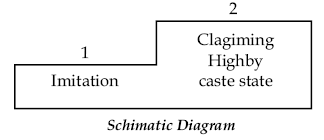
Tribe-Caste Continuum (TCC) is defined as a gradual transition from tribe condition to caste condition,leading to high similarities or overlap of customs, traditions or norms between two, making it difficult to separate the two at intermediate levels.
Question : What do you understand by dynamics of caste mobility? How did the concept of sanskritization contribute to its functionality?
(2015)
Answer : Caste mobility as a process of social and cultural change has been explained by M. N. Srinivas in his concept of Sanskritisation. The widespread social and cultural process called Sanskritization is a process, where a low Hindu caste changes its customs, rites, rituals, ideology and way of life in the direction of high and specifically twice-born castes.
This has paved the way for mobility to occur, within the caste system. ....
Question : Sacred complex as a dimension of Indian civilization.
(2015)
Answer : Sacred Complex is happy synthesis of sacred geography, sacred specialist and sacred performance of Hindu place of pilgrimage reflecting the compromise, continuity & combination between Great and Little Tradition.
The sacred complex is based on the idea given by Robert Redfield that all primary civilizations have a centre for diffusion of culture. In Indiait was first identified and explained by L. P. Vidyarthi as ‘Sacred Complex of Hindu Gaya’ (1961).
L.P.Vidyarthi identified three components ....
Question : Islam and Matriliny.
(2015)
Answer : While Islam is a religion based on patrilineal system, but few of the converted people of India still trace some patterns of their customary laws based on matrilineal descent.
Matrilineality is defined as the tracing of roots through female line. Among the mainstream India this system is widely prevalent in Kerala region.
Leela Dube is best known for her work on Muslim matriliny in Lakshwadeep, Matriliny and Islam: Religion and Society in the Laccadives (1969) and ....
Question : Define the concept “Dominant Caste” and examine its relevance in the contemporary Indian Village with suitable examples.
(2014)
Answer : The concept of dominant caste has been used for the first item in sociological literature by an eminent Indian Anthropologist M.N. Srinivas in his essay social system of a Mysore Village, which was written after his study of village Rampur. While constructing the concept, perhaps Srinivas was unconsciously influenced by African studies on the dominant clan and dominant lineage. Srinivas developed the concept in his study of Rampura village which is a ....
Question : Contribution of H. H. Risley to the ‘Aryan’ debate.
(2014)
Answer : The concept of dominant caste has been used for the first item in sociological literature by an eminent Indian Anthropologist M.N. Srinivas in his essay social system of a Mysore Village, which was written after his study of village Rampur. While constructing the concept, perhaps Srinivas was unconsciously influenced by African studies on the dominant clan and dominant lineage. Srinivas developed the concept in his study of Rampura village which is a ....
Question : Tribe-Caste continuum.
(2014)
Answer : Tribe-caste continuum means transformation of a tribal group into a caste group. In the ancient society caste originated on the basis of division of labour. The tribe evolved on the basis of community feeling of communities inhabiting a definite geographical area. Tribe-Caste Continuum (TCC) is defined as a defined as the gradual transition from tribe condition to caste condition leading to high similarities or overlap of customs, traditions or norms between two, making it difficult ....
Question : Discuss the contributions of Islam to the composite culture of India.
(2014)
Answer : The culture of India refers collectively to the thousands of distinct and unique cultures of all religions and communities present in India. India’s languages, religions, dance, music, architecture, food and customs differ from place to place within the country.
The contact of India with Islam is more than 1000 years old and today it is the 2nd most popular religion of India. During these years, interactions have happened in almost all fields and the modified features ....
Question : Describe what is known of Harappan Religion. Have some of its elements continued into later Hinduism? Discuss.
(2014)
Answer : On the basis of information gathered from Harappan seals, seal impressions, terracotta and metal figures, cemeteries, etc. we can come to the conclusion that worship of the Mother Goddesses was very much prevalent in the society.
It is very much to the point to underline the fact that worship of Mother Goddesses came into vogue in Hinduism one thousand years after the decline of Harappan culture. Other traits of later Hinduism such as worship of Pashupati ....
Question : Discuss how Louis Dumont explained caste system.
(2013)
Answer : Louis Dumont, a French anthropologist, defined Indian Caste system as “A set of economic, political and kinship relation sustained by certain values, which are mostly religious”.
Being a follower of Durkheimian tradition, he focused on the study of Indian ideology of social personhood as reason behind Indian hierarchy. This hierarchy is based on concept of religious purity and pollution.
Dumont highlights the state of mind which is expressed by the emergence in various situations of castes. He ....
Question : What is Jajmani system? Examine the views on Jajmani system as an egalitarian as well as exploitative system. Give reasons for its decline.
(2013)
Answer : Jajmani system is a system of distribution whereby land owning families belonging to higher castes are provided services and products of various lower castes such as Khati (carpenter), Nai (barber), Kumhars (potters), Lobars (blacksmiths), Dhobi (washer man), Sweeper (chuhra) etc.
The servicing castes are called Kamins while the castes served are called Jajmans. The term Jajmani has its origin in the Sanskrit word ‘yajnaman’ meaning ‘patron’ or client. The patron caste is at the centre of ....
Question : Examine the criticisms on the concept of dominant caste.
(2013)
Answer : The concept of dominant caste was used for the first item in sociological literature by an eminent Indian Anthropologist, M.N. Srinivas, in his essay ‘Social System of a Mysore Village’, which was written after his study of village Rampur.
The term dominant caste is used to refer to a caste which “wields economic or political power and occupies a fairly high position in the hierarchy”. These castes are accorded high status and position in all the ....
Question : Discuss the social disabilities suffered by scheduled castes.
(2013)
Answer : The Varna system which existed during the Vedic period, in course of time, degenerated into the caste system. Since then, the Scheduled Castes who are known as ‘Untouchables’ have been suffering from various social, religious, political, legal, economic, educational and other disabilities. For centuries they were denied political representation, legal rights, civic facilities, educational privileges and economic opportunities. During the British rule also, nothing was done to uplift the Scheduled Castes and to relieve them ....
Question : Examine the nature-man-spirit complex as an ecological concept.
(2013)
Answer : In tribal India, on the one hand, there is an intimate relationship and interaction between social organizations and on the other hand, between religious complex and ecological conditions. In certain circumstances, it appears that nature and spirit condition some of the social ways and practices while in others it sounds as a case of adjustment for smooth living.
At times the relationship appears unavoidable; its avoidance would cause hardship to the people. But at other places, ....
Question : Sufism tradition in Islam.
(2013)
Answer : Sufism refers to the mystical Islamic belief and practice wherein Muslims seek to find the truth of divine love and knowledge through direct personal experience of God. It consists of a variety of mystical paths that are designed to ascertain the nature of humanity and of God and to facilitate the experience of the presence of divine love and wisdom in the world.
It is considered as a movement similar to Advaita movement of Hinduism. It ....