
Question : Write notes on the following in about 150 words each:
(2018)
Answer : (a) Youth dormitory as an institution
Ans: The tribal dormitories in India are an ancient tradition that put all of the youth of a village together. The most important social institution in the tribal social organization is youth dormitory. These organizations are found in almost every tribe and their social life is centred on it.
They are known by different names in different tribes, for example, among the Nagas of Assam, they are called ‘Morung’, while the ....
Question : Discuss the various factors resulting in tribal unrest in various parts of India.
(2018)
Answer : For ages, tribals were considered a primitive segment of Indian society. They lived in forests and hills without having more than a casual contact with the so called civilised and advanced neighbours. There being no population pressures, there was no attempt to penetrate their areas and impose alien values and beliefs on the tribals. But when the British consolidated their position in the country, their colonial aspirations and administrative needs necessitated ‘opening up’ the entire ....
Question : Examine the colonial administrators’ view that Indian villages can be considered as ‘little republics’.
(2018)
Answer : The idea of the village has occupied an important place in the history of contemporary India. It has been one of the core categories through which India has been imagined and imaged in modern times. The village has often been seen as an ultimate signifier of “authentic native life”, a place where one could see or observe the “real” India and develop an understanding of the way local people organise their social relationships and belief ....
Question : OBCs among non-Hindu communities.
(2018)
Answer : Other Backward Class (OBC) is a collective term used by the Government of India to classify castes which are educationally or socially disadvantaged.
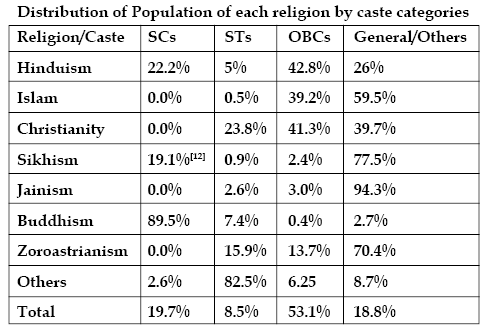
It is one of several official classifications of the population of India, along with Scheduled Castes and Scheduled Tribes (SCs and STs). The OBCs were found to comprise 52% of the country’s population by the Mandal Commission report of 1980, a ....
Question : Critically evaluate the term ‘tribe’ (as used in India) as compared to the term ‘indigenous’ in some other counties.
(2017)
Answer : Indigenous and tribal peoples is a common denominator for more than 370 million people, found in more than 70 countries worldwide. Indigenous and tribal peoples have their own cultures, languages, customs and institutions, which distinguish them from other parts of the societies in which they find themselves.
There is no universal definition of indigenous and tribal peoples, but ILO Convention No. 169 takes a practical approach to the issue and provides objective and subjective criteria for ....
Question : Discuss the constitutional safeguards for the schedule caste.
(2017)
Answer : The position of schedule caste and schedule tribe is always a question mark for the society. Being a developing country we are saying that we are giving an equal status to them as compared with other caste but in reality, it is not like this. In modern time also they are facing problem but we can say that the extent of suffering ness is less as compared to previous time. For improving their conditions government ....
Question : Write short notes on other backward class.
(2017)
Answer : Other Backward Class (OBC) is a collective term used by the Government of India to classify castes which are educationally or socially disadvantaged. It is one of several official classifications of the population of India, along with Scheduled Castes and Scheduled Tribes (SCs and STs).
The OBCs were found to comprise 52% of the country’s population by the Mandal Commission report of 1980, a figure which had shrunk to 41% by 2006 when the National Sample ....
Question : Discuss the emergence, salient features and limitations of Tribal Sub-plan.
(2017)
Answer : Emergence of TSP (Tribal Sub-plan)
Since the beginning of the Planning process, efforts have been made to ensure that the tribal people were included in the growth process. However, the strategy changed with each Five Year Plan as new lessons were learnt from various developmental efforts. The first Five Year Plan emphasized the provision of additional financial resources through a community development approach to address the problems of tribal people rather than evolving a clear cut ....
Question : Give a critical appraisal of any one tribal development programme during XIIth Five-Year Plan. Give your suggestions for any improvement in the programme.
(2017)
Answer : In India, planning processes are being implemented for over six decades. Tribes encounter socio-economic, cultural and political problems. They are considered as a weaker section of the society. The tribal development planning is being implemented along with Five-Year Plans under the control of Government of India. But, Indian tribes are facing some unsolved problems.
The Scheduled Tribes (STs), with a population of 84.33 million as per 2001 Census constituted 8.2 per cent of the country’s population. ....
Question : Tribe as a colonial construct.
(2016)
Answer : The relation of tribes to India is complex. As the colonial powers defined the ‘other’, so the colonized used similar models to define themselves against an ‘other’, whether this be caste, tribes, or religious distinctions. The reasons for these cultural, social, and political constructions were numerous. One of the most important reasons was that of social control. It was crucial for the colonized to maintain a highly inequitable distribution of wealth and power. The creation ....
Question : The role that regionalism plays in demand for autonomy among Indian tribes.
(2016)
Answer : Regionalism is an ideology and political movement that seeks to advance the causes of regions.Regionalism at national level refers to a process in which sub-state actors become increasingly powerful, power devolves from central level to regional governments.
These are the regions within country, distinguished in culture, language and other socio-cultural factors. Regionalism, deeply rooted in our diversity, is a widespread phenomenon among various ethnic groups of the Indian population. While national identity has gained significant grounds, ....
Question : Describe how various tribal development programmes and plans have impacted the process of social transformation among tribes.
(2016)
Answer : The tribals constitute a significant portion of Indian population. Development of an economy is positively related to the tribals-their social, cultural and the economic development.
Development of an economy links its past heritage, with the present. Since independence, many developmental programmes and plans are made by the government for the social, economic and political transformation of various tribes forming nearly 8% of Indian population. But in terms of impact on social transformation process we have mixed ....
Question : Examine the factors responsible for exploitation of schedule caste in india.
(2016)
Answer : The position of the Scheduled Castes (SCs) has a bearing on the social structure of the ‘caste society’, that is, division of Hindu society into caste groups. At the top of the caste hierarchy are Brahmanas. ‘Untouchables’ come at the bottom. There are several caste groups in between. Ritual pollution and purity based on birth in a particular caste group is considered as the basis of high and low caste ranks. Scheduled castes are among ....
Question : Write in detail various provisions provided by the Constitution of India for the Scheduled Tribes under Fifth and Sixth Schedules.
(2016)
Answer : Tribal welfare and development with protection of tribal identity is a significant aspiration of Indian Constitution. To fulfil these aspirations,Indian Constitution makers provided for 5th and 6th Schedule extending to various tribal regions under Article 244.
5th Schedule
Article 244 (1) extends the provisions of 5th Schedule to the administration and control of Scheduled Areas and Scheduled Tribes in any state other than the states of Assam, Meghalaya, Tripura and Mizoram. Important constitutional provisions under 5th Schedule ....
Question : Critically compare ‘Affirmative Action’ of USA and ‘Protective Discrimination’ for scheduled tribes in India.
(2015)
Answer : On outside, the concepts are similar and are often used in place of each other, but they differ in some provisions from each other.
Question : Discuss the nature of social change in tribal India under the impact of developmental programmes.
(2015)
Answer : Social transition leads to social transformation, a shift in terms of human aspiration which is readily available, accessible and easy to get with comfortas its ultimateobjective. The process of social transformation may restructure the technological, economic, political and cultural patterns in a society.
Since independence many developmental programmes are initiated by the government of India to address the problems of tribal societies and uplift their social condition in terms of education, health, civic facilities, etc. The ....
Question : Role of governor in Fifth Schedule Areas
(2015)
Answer : The Fifth Schedule deals with administration of scheduled areas where tribal communities are in a majority. In the Article 244(1) of the Constitution, expression ‘Scheduled Areas’ means such areas as the President may by order declare to be Scheduled Areas.
The Governor holds significant powers and responsibilities for the 5th schedule areas under Article 244 of the Indian Constitution. These powers are vested to protect the tribals from the people from outside and the laws made ....
Question : Critically examine the constitutional provisions for safeguarding the interests of Scheduled Tribes in India.
(2014)
Answer : The founding father of the Indian Constitution, Dr. Babasaheb Ambedkar and other members were aware of the political, social and economic inequalities, which existed in the country due to historical reasons. They were aware of the prevailing miserable and appalling conditions of the Scheduled Tribes who had remained far behind and segregated from national life. It became imperative, therefore, to adopt a policy of protective discrimination as an equalizer to those who were too weak ....
Question : Discuss the rise of ethno-nationalism among Indian tribes with specific example.
(2014)
Answer : Ethnic nationalism is a form of nationalism wherein the “nation” is defined in terms of ethnicity. Whatever specific ethnicity is involved, ethnic nationalism always includes some element of decent from previous generations and the implied claim of ethnic essentialism, i.e., the understanding of ethnicity as an essence that remains unchanged overtime.
The central theme of ethnic nationalists is that nations are defined by a shared heritage, which usually includes a common language, a common faith, and ....
Question : What are the significant factors responsible for tribal unrest?
(2014)
Answer : For ages, tribals were considered a primitive segment of Indian society. They lived in forests and hills without having more than a casual contact with the so-called civilised and advanced neighbours. There being no population pressures, there was no attempt to penetrate their areas and impose alien values and beliefs on the tribals. But when the British consolidated their position in the country, their colonial aspirations and administrative needs necessitated ‘opening up’ the entire country ....
Question : Discuss the social disabilities suffered by scheduled castes.
(2013)
Answer : The Varna system which existed during the Vedic period, in course of time, degenerated into the caste system. Since then, the Scheduled Castes who are known as ‘Untouchables’ have been suffering from various social, religious, political, legal, economic, educational and other disabilities. For centuries they were denied political representation, legal rights, civic facilities, educational privileges and economic opportunities.
During the British rule also, nothing was done to uplift the Scheduled Castes and to relieve them from ....
Question : Discuss the criticism levelled against anthropology in the context of ‘isolation and assimilation debate’ on tribal population.
(2013)
Answer : Approaches to tribal development in India are based on three models, to conserve, assimilate and integrate. Experiences of isolation and assimilation policy (well defined by Ghurye, 1963) forced thinkers, anthropologists, and social reformers to adopt something in midway of isolation and assimilation because the base of Indian culture is “Unity in diversity”. Consequently, social reformers, politicians, and anthropologists experts developed a new approach called integration approach.
The isolation and assimilation debate is based on the opposing ....
Question : Examine the impact of non-tribal contact on socio-cultural institutions of tribal people with suitable examples.
(2013)
Answer : L.M. Lewis believes that tribal societies are small in scale and are restricted in the spatial and temporal range of their social, legal and political relations and possess a morality, a religion and world view of corresponding dimensions. Tribals are like an iceberg in ocean having continuous erosion since the colonial contact with them. Today many tribals are assimilated by various nontribal groups and their life including socio cultural features have changed significantly by these ....
Question : Ethnic movements in India.
(2013)
Answer : Ethnicity