
Question : Assess the importance of the accounts of the Chinese and Arab travellers in the reconstruction of the history of India.
(2018)
Answer : Travelers from foreign lands played a major role in deciphering Indian history. In this light, Chinese and Arab travellers have a major part to play as they had over many centuries visited the Indian subcontinent and also because many of them have written and documented their travels extensively. These travelogues are a source of information of not only the routes of these travellers but also contain information about the various regions through which they passed, ....
Question : Clarify how mid-eighteenth-century India was beset with the spectre of a fragmented polity.
(2017)
Answer : The 18th century is considered as a period of transition.
Question : Why did the ‘Moderates’ failed to carry conviction with the nation about their proclaimed ideology and political goals by the end of the nineteenth century?
(2017)
The Early Nationalists had full faith in the British sense of justice, fair play, honesty, and integrity while they believed that British rule was a boon for India. The ....
Question : What problems are germane to the decolonization process in the Malay Peninsula?
(2017)
Answer : 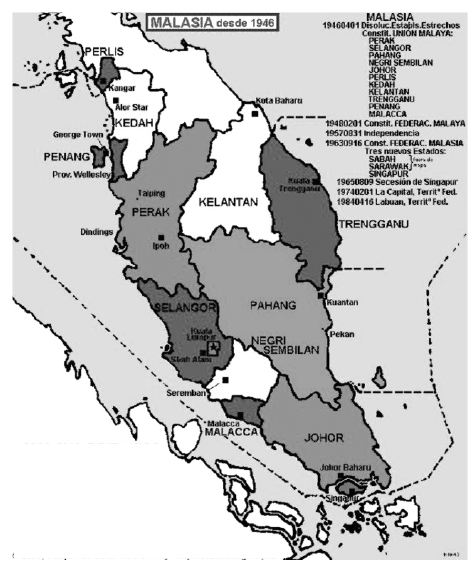
Question : Examine how the decline of traditional artisanal industry in colonial India crippled the rural economy.
(2017)
Question : Highlight the importance of the new objectives that got added to the vision of Indian Independence since the twenties of the last century.
(2017)
Answer : Indian independence struggle had certain vision and the method of attaining that mission kept on changing its character according to the situation of the society in freedom struggle.
The year 1920 and after is considered an important period in the struggle of freedom because it was the year when Non-cooperation movement was started which gave a systematic style of satyagraha and the successive initiatives further enriched the freedom struggle in the following ways:
Non-Cooperation Movement: It was ....
Question : Explain how the upraising of 1857 constitutes an important watershed in the evolution of British policies towards colonial India.
(2016)
Answer : The uprising of 1857, also known as the Sepoy Mutiny was the first nationalist movement by Indians against colonial exploitation by an apathetic British rule, which played a crucial role in determining British policies towards Colonial India till independence. This led to several structural and functional changes in the policies of British towards India which had both positive and negative spillovers.
Majority of the British policies post 1857 were aimed at curbing the growth of nationalism ....
Question : Discuss the role of women in the freedom struggle especially during the Gandhian phase.
(2016)
Answer : The history of Indian Freedom Struggle would be incomplete without mentioning the contributions of women. Their sacrifices occupy an important place as they fought with true spirit and undaunted courage enduring torture and hardships. They took charge of the struggle whenever most of the men freedom fighters were in prison.
Women had been actively fighting the British even before the Revolt of 1857. Later, they showed an active participation in the Congress and its political movements ....
Question : Highlight the differences in the approach of Subhash Chandra Bose and Mahatma Gandhi in the struggle for freedom.
(2016)
Answer : Both Mahatma Gandhi and Subhash Chandra Bose were honest internationalists and humanists. They were secular in approach and anti-racial in outlook and had great mutual admiration for each other. In spite of all this, there were glaring differences between Gandhi and Bose and in many situations were poised against each other.
Young Netaji Bose was an extremist, socialist and a firebrand nationalist who followed Tilak and Aurobindo’s path. Gandhi, on the contrary, was a moderate and ....
Question : Has the formation of linguistic States strengthened the cause of Indian Unity?
(2016)
Answer : Yes. Perhaps linguistic division is one of the reason for the success of Indian federation, in contrast to the crumbling of various homogenous nation states which were marred with civil unrest and in worst cases-disintegrated. (USSR, Sri Lanka)
Unification of Germany and Italy populated by similar people was achieved by huge armies spanning across decades. In sharp contrast, India under Sardar Vallabhbhai Patel managed to unite a much larger area divided by culture & languages within ....
Question : The anti-colonial struggles in West Africa were led by the new elite of Western-educated Africans. Examine.
(2016)
Answer : Anti-colonial movements in Africa were responses to European imperialism on the continent in the late nineteenth century and the greater part of the twentieth century and African responses to colonial rule varied from place to place and over time.
Several forms of both armed and nonviolent resistance to colonialism occurred. Armed violence was mostly used by the small tribes of Africa which could not succeed against colonizers as they were not united or mighty.
Nonviolent forms of ....
Question : How different would have been the achievement of Indian independence without Mahatma Gandhi? Discuss.
(2015)
Answer : The formation of Congress in the year 1885 can be seen as a first political stage that paved the way for Indian Independence movement. Till the year 1919, the congress was largely dominated by the moderates and the extremists, who did not, represented the masses. In the year 1919, Gandhiji formally entered institutional politics by joining congress. He emerged as the national leader representing the interests of all the sections of the Indian people in ....
Question : It would have been difficult for the Constituent Assembly to complete its historic task of drafting the Constitution for Independent India in just three years but for the experience gained with the Government of India Act, 1935. Discuss.
(2015)
Answer : The constituent assembly adopted many provision of the Government of India act 1935. A critic has portrayed the Indian constitution “as a glorified edition of the 1935 Act”. Dr. Jennings remarks, “The Constitution derives directly from the Government of India Act of 1935 from which in fact many of the provisions are copied almost textually”. Articles 256, 351, 352, 353, 356 are carbon copies of sections 126, 107, 102 and 93 of 1935 Act respectively. ....
Question : The Third battle of panipat was fought in 1761. Why were so many empire-shaking battles fought at Panipat?
(2014)
Answer : The empire-shaking battles that changed the fate of India’s ruling power, be it from Delhi sultanate to beginning of Mughal empire at First battle of panipat in 1526 between Babur and Ibrahim Lodiand by the Third Battle of Panipat was fought in 1761 between the Afghan invader Ahmad Shah Abdali and the Marathas under Sadashivrao Bhau Peshwa of Pune. Ahmad Shah won but with a very heavy casualty rate on both sides. It resulted in ....
Question : Examine the various facets of economic policies of the British in India from mid-eighteenth century till independence.
(2014)
Answer : Indian Economy before British rule was self-sufficient and is majorly driven by agriculture and local handicrafts industry. So, Indian economy was closed one and fulfilled all its domestic needs from domestic market itself. With the advent of British Empire, which started to exploiting the natural resources of India and it favoured the interest of British Economy. British Economic exploitation of India can be understood by three phases as suggested by R.P Dutt, member of Communist ....
Question : In what ways did naval mutiny prove to be the last nail in the coffin of British Colonial aspirations in India.
(2014)
Answer : Post Second World War British start losing its faith in the masses of Colonial regions especially in India with the most violent Quit India movement. Indians not supporting British in World War followed by series of uprisings starting from Naval mutiny to peasant movements proved to be the last nail in the coffin of British Colonial aspirations in India. Second World War changed the balance of power in the world from Britain to USA. Though ....
Question : What were the major political, economic and social developments in the world which motivated anti-colonial struggle in India?
(2014)
Answer : Indian National Movement was an anti-colonial struggle against the British rule who exploited Indians and India’s natural resources that affected all section of people because of uniform administration structure by the British in India. Nationalist and masses got all motivational factors not only from India’s past glory but also from major developments that took around the world in political, economic and social spheres which influenced Indian masses and further geared up the anti-colonial struggle.
British introduced ....
Question : What were the events that led to the Suez crisis in 1956? How did it deal a final blow to a Britain’s self-image as a world power?
(2014)
Answer : Middle East region was a key area in the cold war era, where Britain had ruled Egypt in 20th century with implementation of strong military forces along the Suez Canal. Because Suez Canal is considered as strategic importance which connects the Europe with the Asian continent and reduces the travel time on the ocean journey, instead one has to travel around volatile Cape of Good Hope unnecessarily.
The causes of the Suez Canal Crisis of 1956
Egyptians ....
Question : The New economic policy – 1921 of Lenin had influenced the policies adopted by India soon after independence. Evaluate.
(2014)
Answer : The New Economic Policy (NEP), 1921 was introduced by Lenin to replace the failed policy of War Communism. NEP had some capitalistic element in order to achieve economic growth. Under the NEP, Lenin introduced following measure.
Question : Defying the barriers of age, gender and religion, the Indian women became the torch bearer during the struggle for freedom in India. Discuss.
(2013)
Answer : The entire history of the freedom movement is replete with the saga of bravery, sacrifice and political sagacity of great women of the country. Their participation in the struggle began as early as 1817 when Bhima Bai Holkar fought against the British Colonel Malcolm and defeated him in guerilla warfare.
Some important women freedom fighters are as follow:
Lakshmi Bai: She protested against the ‘Doctrine of Lapse’. She refused to surrender Jhansi and fought bravely attired as ....
Question : Several foreigners made India their homeland and participated in various movements. Analyze their role in the Indian struggle for freedom.
(2013)
Answer : The foreign personalities associated with such movements are:
A.O Hume: He was a civil servant, political reformer and amateur orinthologist and horticult-uralist in British India. He was one of the founders of the Indian National Congress, a political party that was later to lead the Indian independence movement.
Sir William Jones: In 1784 he founded the Asiatic Society of Bengal to encourage Oriental studies. In his 1786 presidential discourse to the Asiatic Society, he postulated the common ....
Question : In many ways, Lord Dalhousie was the founder of modern India. Elaborate.
(2013)
Answer : The contributions of Lord Dalhousie to India can be attributed as:
Question : Discuss the contribution of Maulana Abul Kalam Azad to pre-and post independent India.
(2013)
Answer : Maulana Abul Kalam Azad stood for a learning society through liberal, modern and universal education combining the humanism of Indian arts and the rationalism of western sciences, a society where the strong are just and the weak secure, where the youth is disciplined and the women lead a life of dignity– a non-violent, non-exploiting social and economic order. He was free India’s first Education Minister and guided the destinies of the Nation for eleven years.
He ....
Question : Analyse the circumstances that led to Tashkent Agreement in 1966. Discuss the highlights of the agreement.
(2013)
Answer : Tashkent Agreement was signed between India’s then Prime Minister Lal Bahadur Shastri (who died the next day after signing thereof) and Pakistan’s President Ayub Khan, ending the 17-day war between Pakistan and India of August-September 1965. A cease-fire had been secured by the United Nations Security Council on Sept. 22, 1965.
The agreement was mediated by Soviet premier Aleksey Kosygin, who had invited the parties to Tashkent. The parties agreed to withdraw all armed forces to ....
Question : Critically examine the compulsions which prompted India to play a decisive role in the emergence of Bangladesh.
(2013)
Answer : The liberation movement of Bangladesh began on 26 March 1971 and ended with the liberation of Bangladesh on 16 December 1971. The armed struggle was the culmination of a series of events, situations and issues contributing to the progressively deteriorating relations between East and West Pakistan. The questions of land reforms, state language, inter-wing economic and administrative disparities, provincial autonomy, and the defence of East Pakistan.
India had played a decisive role in the emergence of ....
Question : “Latecomer” Industrial revolution in Japan involved certain factors that were markedly different from what west had experienced.
(2013)
Answer : The industrial revolution began in about 1870 when Meiji period leaders decided to catch up with the West.
Causes of modernization in Japan
Question : Africa was chopped into states artificially created by accident of European competition. Analyse.
(2013)
Answer : The New Imperialism (or Neo-imperialism) was a period of colonial expansion-and its accompanying ideologies-by the European powers, the United States and the Empire of Japan during the late 19th and early 20th centuries. By some accounts, it began as early as 1830, and may have lasted until the Second World War (1939-45). The period is distinguished by an unprecedented pursuit of overseas territorial acquisitions. At this time, countries focused on building their empire with new ....
Question : American Revolution was an economic revolt against mercantilism. Substantiate.
(2013)
Answer : Socially and economically, the thirteen British colonies in North America fell into two groups.The southern colonies, Virginia the largest among them, had largely plantation-based agrarian economies dominated by planter elite and worked by African and African-American slave laborers. These plantations focused on cash crop production for the Atlantic economy. The northern colonies had relatively large commercial and handicraft sectors, dominated by mercantile capitalists and worked by indentured servants and free artisan labor. Northern agriculture featured ....
Question : "The Indian independence movement was a mass-based movement that encom-passed various sections of society. It also underwent the process of constant ideological evolution." Critically examine.
(2012)
Answer : After the revolt of 1857, The Indian Independence Movement started taking an organized shape. The movement was basically led by only one organized institution i.e. the Congress.
Right from the beginning, Congress members were a group of intellectuals and till independence most Presidents of Congress came from the English educated professional class. While the Congress portrayed itself as centrist in its orientation, it could not get the cooperation of all Indian communities. Muslims in the 1920's ....
Question : The significance of Patharughat in the Indian freedom struggle.
(2012)
Answer : Patharughat, in Darrang district, of Assam is the place where peasants rebelled against the imposition of exorbitant taxes in 1894. Altogether 140 peasants were gunned down under the order of military police officiating commandant J R Berington when unarmed peasants gathered at Patharughat to raise slogans against the strict tax regime on January 28, 1894.The peasants' revolt known as Jallianwala Bagh of Assam is one of the landmark events in the state's freedom ....
Question : Trace the Salient sequence of the events in the popular revolt that took place in February 1946 in the then Royal Indian Navy and bring out its significance in the freedom struggle. Do you agree the view that the sailors who took part in this revolt were some of the unsung heroes of freedom struggle?
(2011)
Answer : The Royal Indian Navy Mutiny or the Bombay mutiny was the revolt of the Indian sailors. The sailors who belonged to RIN on board ship and shore establishments at Bombay Harbour went for a strike and organised a mutiny on 18th Feb, 1946. The whole mutiny involved 78 ships, 20 shore establishments and 20,000 sailors. This revolt subsequently came to known as RIN revolt. It started as a protest against their general conditions.
The immediate reason ....
Question : Evaluate the influence of the three important women's organisations of the early 20th century in India on the country's, society and politics. To what extent do you think were the social objectives of these organisations constrained by their political objectives?
(2011)
Answer : Bharat Stree Mahamandal, All India Women’s Conference and Women’s India Asso-ciation were some of the important women’s associations of the early twentieth century. Bharat Stree Mahamandal was the first women's organisation in India founded by Sarala Devi Chaudhurani in Allahabad in 1910. One of the primary goals of the organisation was to promote female education which was not well developed at that time. The organisation opened several offices in Lahore, Allahabad, Delhi, Karachi, Amritsar etc. ....
Question : Bharat Naujawan Sabha
(2011)
Answer : Naujawan Bharat Sabha was an association of Indian youth which was established at a convention held in April 1928 at the Jallianwala Bagh in Amritsar. The aims of the Sabha were to create a youth wing of peasants and workers with a view to usher in revolution in the country and overthrow the British rule. The Sabha remained active between March 1926 and April ....
Question : Babbar Akali Movement
(2011)
Answer : Babbar Akali Movement, emerged in the wake of the Akali Movement, and was an underground terrorist movement established in the Jalandhar Doab in 1921. The Babbar Akalis were Gur Sikhs, who were against the imperialist policies of the British Government. Babbar Akalis did not approve of the Congress leadership and were against the Gandhi formula of non-violence and ....
Question : “Dalhousie’s predecessors had acted on the general principles of avoiding annexation, if these could be avoided. Dalhousie acted on the principles of annexation, if he could do so legitimately. His annexations were both of war and peace.” Analyse.
(2010)
Answer : Before Wellesley British has followed the policy of consolidating their gains and resources in India and making territorial gains only when this could be done safely without antagonising the major Indian powers. However, Wellesley and his successors decided that the time was ripe for bringing as many Indian states as possible under British control. Thus predecessors of Dalhousie followed the policies of outright wars to annex powerful empires under Tipu Sultan and Maratha confederacy. Under ....
Question : Contributions of Latika Ghosh to the freedom struggle
(2010)
Answer : Latika Ghosh was an Oxford scholar. She established the Mahila Rashtriya Sangha in Chiitagong in 1928 at the behest of Netaji Subash Chandra Bose. The aim of the MRS was to fight for freedom through the mobilization women for political work. Mahila Rashtriya Sangha was started to organize women to resist the Simon Commission. She worked in close connection with the Congress and entailed 300 women students in her mission by ....
Question : Bhai Maharaj Singh as a freedom fighter
(2010)
Answer : Bhai Maharaj Singh was the nationalist spiritual Sikh leader known as the first freedom fighter of India who took up weapons against the British rule in 1847 after the First Anglo-Sikh ....
Question : Critically analyze any two of the following statements with reference to the context in which they were made.
(2009)
Answer : (a) "Many Englishmen honestly consider themselves the trustees for India and yet to what a condition they have reduced our country".
During the 1930s a divide can be witnessed between Gandhian methods and other prominent Congress leaders particularly, Bose and Nehru. The deadline given by the Calcutta Congress (1928) to the Government for giving India the dominion status was near. The liberals, Gandhi and even Nehru, signed Lord Irwin's Delhi Statement but Irwin flatly rejected congress' ....
Question : "Satan cannot enter till he finds a flaw … A great ocean separate us educated few from the millions in our country".
(2009)
Answer : The Swadeshi Movement was relatively successful in maintaining communal harmony but in the later phases there arose certain tendencies on divisive lines. It took the form of riots in east Bengal. The elite-politics of Salimullah group and the Muslim League (established in 1906) etc. with the incitement of administration can be termed as the major actors in these events. The scholars have seen these in the context of economic matters. It can be said that ....
Question : Write about the following (not exceeding 20 words each)
(2009)
Question : “British vision of India had no single coherent set of ideas. On the contrary, the ideas were shot through with contradictions and inconsistencies.” Discuss.
(2008)
Answer : British rule in India was based on opportunities provided by the situations in different time periods so the British rule lacked vision and was filled with contradictions and inconsistencies. This can be manifested by different political, economic, social and cultural policies of British rule. Sometimes it differed from one governor general. This can be easily deciphered from the British Policy towards Princely States. It started with equal partnership to subsidiary alliance then to doctrine of ....
Question : “Non-Cooperation Movement gave new direction and energy to the National Movement.” Explain.
(2008)
Answer : Special Congress session at Calcutta accepts policy of progressive Non-Cooperation with the unjust government. Through Non-Cooperation Movement congress hoped to paralyse the functioning of civil administration of the unjust foreign government by withdrawing all cooperation from it.
During Non-cooperation Movement Gandhi emerged as a great leader. His saintly figure and charismatic personality won many followers. During NCM, Gandhi won over the Muslims for Non-cooperation. Congress became a movement of the massed peasants in villages, workers in ....
Question : Write about the following (not exceeding 20 words each):
(2008)
Answer : Lakshmi Bai, Rani of Jhansi: Lakshmi Bai, Rani of Jhansi revolted against British when Jhansi was annexed by the application of the Doctrine of Lapse.
Ilbert Bill: Ilbert Bill (1883-84) formed by a law member of the Viceroy’s council Sir. C.P. Ilbert which abolished judicial disqualification based on race. It was passed when Lord Rippon was Viceroy.
Lala Hara Dayal: Revolutionist, journalist, educationalist and founder member of Gadar Party Lala Hara Dayal established a bureau in India ....
Question : “The emergence of new social classes in British India was the direct consequence of the establishment of new social economy, new state system, administrative machinery and Western education.” Discuss.
(2008)
Answer : When British entered India, it was not a unitary state. There were prescence of many Princely states. Some states were prosperous and some were not. Indian over all social, economic condition had not developed.
British introduced many social reform measures like abolition of Sati in 1829, widow Remarriage Act 1856, and etc. Created infrastructure like introducing railways in India. These railways helped industries to get access to the market and also the raw material centres.
British introduced ....
Question : The crisis of the colonial order during 1919 and 1939 was directly linked to the constitutional reforms, disillusionment and militant anti-colonial struggles. Elucidate.
(2007)
Answer : The colonial order faced a threa-tening crisis in India as all over the world during 1919 and 1939. Some revolutionary activities had created a trouble in colonial order, even before the end of the First World War. The promises which the British Government made for the Indian people during the First World War were not fulfilled. Rowlatt Act and the incident of Jallianwala Bagh enhanced mass dissatisfaction further. British government introduced several constitutional reforms during ....
Question : What are the salient features of the Government of India Acts of 1858 and 1909?
(2007)
Answer : British Government had a lesson from the 1857 revolt. To establish their rule in India permanently, British had to find out new policies. For this, the Act of 1858 was introduced. Through this Act India’s rule came directly under British Crown for a smooth administration. British established a 15 member committee and a secretary of state. Under this Act there were changes in the army and the administrative system, according to the need. In the ....
Question : Do you think Mahatma Gandhi's support to Khilafat Movement had diluted in secular credentials? Give your arguments based on the assessment of events.
(2007)
Answer : Critiques say that supporting Khilafat Movement by Gandhiji was a backward step. To some extent this was right also, because for the first time leaving the secular policies, keeping religion as the theme, the All India Movement started working. As a result the religious, communal issues were encouraged. However we should mention that in the immediate situation, it was of the utmost importance to have support from all class and section of the country to ....
Question : Evaluate the contribution of revolutionary terrorism represented by Bhagat Singh to the cause of India’s struggle for independence.
(2007)
Answer : To use the non-violent movement for the independence of India seemed a difficult task to the youth. The youths separated from the moderates and tried to find out alternate ways for the Gandhian policies; during this time only, the violent means and strength were used as a medium to end the British rule. Bhagat Singh was the main pillar of this policy. Under Bhagat Singh’s leadership in 1928 the freedom fighters established the Hindustan Republican ....
Question : What was the character of socio-religious reforms in the 19th Century and how did they contribute to the national awakening in India?
(2007)
Answer : In 19th century the process of religious reform had started almost in all Indian religions. The contemporary Indian social system was associated with religion. Naturally religious reforms and social reforms were complementary to each other. In the 19th century, a lot of socio-religious reform movements took place; like in Hindu religion, the Brahma Samaj and Arya Samaj, in Muslim religion Aligarh and Ahmedia movement, in Sikh religion Akali movement and in Parsi religion Rahnumai Majdayasan ....
Question : Write about the following (not exceeding 20 words each)
(2007)
Answer : The Age of Sangam Literature: It was the age of the great literatures during 1st century B.C. to 3rd century B.C. under the Chola & Pandya rulers in which the Tamil poets created great literary works.
Bhakti: It was a form of worshipping of deities through total devotion and love for the gods and believing that the gods answer the prayers for their love to the devotees.
Ashtadhyayi of Panini: It is mainly a grammar book. In ....
Question : Regardless of distance in time, there were lots of similarities between Lord Curzon and Jawaharlal Nehru. Discuss.
(2007)
Answer : Lord Curzon and Jawaharlal Nehru has been the top administrator of India at two different period of time. Lord Curzon was the viceroy of India during 1899 to 1905 while Nehru became the Prime Minister of India 1947 (i.e. after independence). Although there is a difference of almost 50 years between the administrations of these two but there were lots of similarities can be seen in the administration and policies followed by them.
Nehru and Curzon ....
Question : How did the Government of India Act, 1935 mark a point of no return in the history of constitutional development in India?
(2006)
Answer : The Government of India Act, 1935 was a landmark in the history of constitutional development in India. After the Third Round Table Conference, the British Government published a white paper in March 1933 containing an outline of a new constitution. The scheme contained provisions for a federal setup and provincial autonomy. It proposed Diarchy at the centre and responsible governments in the provinces. The British parliament constituted a joint committee of the two Houses to ....
Question : What was the attitude of Indian Industrialists towards the Indian National congress in the pre-independent era?
(2006)
Answer : An important development in the second half of the 19th Century was the establishment of large-scale machine based industries in India. It led to the emergence of two new classes Industrialists or Capitalists and the modern workers class. From the very beginning the attitude of these new classes was favourable towards the National movement. It is important to note that the Industrial development in India took place without government help and in opposition to British ....
Question : Critically assess Sir Tej Bahadur Sapru’s views on Indian Nationalism.
(2006)
Answer : Sir Tej Bahadur Sapru was the main pillar of National movement during Liberal phase. His impact can be seen as the liberal attitude of National movement. He was instrumental to bring back Tilak and many other revolutionary leaders in to the congress in 1916. Thus, it can be said that he worked as a bridge between liberals and revolutionaries. He gave Indian National Movement a new form and direction.
He was an advocate, and fights many ....
Question : Characterise the main features of Indian Renaissance.
(2006)
Answer : The consolidation of British Supremacy in India during the 18th and 19thcentury reflected the obsolescence of Indian social practice and institution with the growth of colonial dominance, a new intelligentsia deve-loped which imbibed the liberal western culture and recognized the need to raunchy movements to reform social institutions and religious outlooks inherited from the past. The targets of the severest intellectual attack were the existing social cultural evils and malpractices such as obscurantism, superstitious and ....
Question : What in your opinion were the positive steps taken by the British to modernise India?
(2005)
Answer : Firstly, the British introduced the modern concept of the rule of law. Their administration was to be carried out in obedience to laws, which clearly defined the rights, privileges, and obligations of the subjects. One important feature of the concept of the rule of law was that any official could be brought before a court of law for breach of official duty or for acts done in excess of his official authority.
Secondly, the Indian legal ....
Question : Examine the policy of subordinate Union towards Princely States. Account for the shift from the policy of Subordinate Isolation. (About 250 words)
(2005)
Answer : The Queen's Proclamation announced the abandonment of the policy of annexation. The Doctrine of Lapse was buried and an assurance was given that the crown desired no extension of present territorial possessions.
The immunity from the policy of annexation was obtained at great cost and lowering the states of Indian princes. Further, the fiction of the Indian princes standing on a status of equality with the crown as sovereign independence states finally came to an end. ....
Question : Discuss the major regulations enacted by the British rulers to curb the freedom of Press in India. (About 250 words)
(2005)
Answer : The circulation of newspapers during the early period of British rule in India never exceeded hundred or two hundred. There was hardly any danger of public opinion being subverted in India. What really worried the company’s officers in India was the apprehension that these newspapers might reach London and expose their misdoings to the Home authorities. In the absence of press laws, the newspapers were at the mercy of the company’s officials.
In 1799 Lord Wellesley ....
Question : Form a critical assessment of the Non Cooperation Movement. (About 250 words)
(2004)
Answer : The Non-Cooperation Movement which was inaugurated by Gandhi on 1 August 1920 took up three main issues, namely-satisfactory solution of the Khilafat question, redressal of the Punjab wrongs and attainment of Swaraj as the ultimate goal of the movement. The movement had a constructive as well as a destructive aspect. Constructive action included raising money for Tilak Swaraj fund, enrollment of members for a volunteer Corps, distribution of spinning wheels to provide work for unemployed, ....
Question : What led to the partition of Bengal in 1905?
(2004)
Answer : The partition of Bengal, according to British was meant to improve the administration of an oversized and under-administered province. Its real objective, however, was to create a Hindu-Muslim divide and to rupture the growing solidarity of the political community in Bengal which had become the nerve centre of Indian nationalism. Calcutta was the centre from which the Congress Party was manipulated throughout the whole Bengal and indeed the whole of India. It was not only ....
Question : Write a note on the Theosophical Society.
(2004)
Answer : The Theosophical society was founded by westerners who drew inspiration from Indian thought and culture. Madame H.P. Blavatsky of Russo-German birth laid the foundation of the movement in the United States in 1875. Later colonel M.S. Olcott of the US Army joined her. In 1882 they shifted their headquarters to India at Adyar, an outskirt of Madras. The members of this society believe that a special relationship can be established between a person’s soul and ....
Question : Discuss the main findings of the Hartog Committee (1929).
(2004)
Answer : The Hartog Committee was appointed in 1929 to look into the deterioration of quality and lowering of standard of education in India. The Committee emphasized the national importance of primary education, but condemned the policy of hasty expansion in education. The committee recommended the policy of consolidation and improvements. For secondary education, the committee reputed that the system was dominated by the Matriculation Examination and many under-serving students considered it the path to university education. ....
Question : Write about the following (about 20 words each):
(2004)
Answer : Upanishads: The literal meaning of Upanishad is ‘to sit near someone’. It marks the culmination of Vedic thought and is about 108 in number. It contains deep speculations of philo-sophic character which revolves around the concept of Atma (self) and Brahma (universal soul).
Vajrayana: Vajrayana or ‘the vehicle of thunderbolt’ owes its origin to Buddhism and appeared in eastern India during the seventh and eighth century. The sect was based on primitive cult and rituals and ....
Question : “The reforms of 1909 introduced a cardinal problem and ground of controversy at every revision of the Indian electoral system”. Comment. (about 250 words)
(2003)
Answer : In 1909, the government introduced some constitutional reforms in India, to please the moderate leaders and strengthen their position in the Congress. These reforms are named after Lord Minto, the Viceroy of India and Lord Morley, the secretary of the state for India, who piloted the bill through the British Parliament. Though it was the first true attempt at introducing a representative and popular element, it was not free from flaws. Given the colonial nature ....
Question : Discuss the problems that impeded the integration of the princely states into the Indian Union. How were these problems tackled? (About 250 words)
(2003)
Answer : During the British rule there were many big and small princely or native states (besides the British India consisting of several provinces) which were indirectly ruled by the British through the princes and chiefs themselves.
After World War II began and a resolution of non-cooperation was adopted by the congress, the British Government tried to break the dead lock through the Cripps Mission (1942), Wavell Plan (1945), Cabinet Mission (1946) and Attlee’s Statement (Feb.1947). But the ....
Question : ‘The mainstay of Mahatma Gandhi’s movements was the rural India’. Elucidate.
(2003)
Answer : Gandhi returned to India in January 1915. His effort in South Africa was well known not only among the educated but also among the masses. He decided to tour the country the next one year to familiar with condition of the masses especially of the people of rural India. He also decided not to take any position on any political matter for at least one year. He was convinced that the only technique capable of ....
Question : Discuss the character of major tribal uprisings in British India in the nineteenth Century.
(2003)
Answer : The tribal people organised the most militant outbursts and insurrections during the 19th century. The colonial administration ended their relative isolation and brought them fully under the ambit of colonialism. The main reasons for their resentment were as follows:
The colonial administration recognized tribal chiefs as Zamindars and introduced a new system of land revenue and taxation of tribal products. It encouraged the influx of Christian missionaries (esp in Bengal and Assam) and thus created serious ....
Question : Bring out the ideological basis of the Moderate-Extremist divide in the Indian National Congress.
(2003)
Answer : The Moderates: The congress programme during the first phase of the Freedom Movement (1885-1905) was very moderate. It was dominated by affluent middle class intelligentsia (men of legal, medical engineering, literary pursuits and journalists). They strongly believed in the essential sense of justice and the goodness of the British nation and followed the policy of gradualism and constitutionalism. It was their belief that the British rule in India was in the interest of the Indians ....
Question : State the four distinctive stages of Indian Demographic history.
(2003)
Answer : The history of population growth in India is fairly in tune with the demographic transition model. The demographic history of India is divided into four distinct phases.
Question : Write about the following (in about 20 words each):
(2003)
Answer : Arthasastra: Of all the secular literary sources on the history of the Mauryas, the single most important source is Arthasashtra written by Kautilya, also known as Vishnugupta and Chanakya. This work is a comprehensive treatise on statecraft and public administration.
Sarnath Pillar: Sarnath is situated near Varanasi. Gautam Buddha delivered his first sermon at this palce which is known as ‘Dharma Chakra Pravartana’. Asoka built a pillar which became famous as Sarnath Pillar. Sarnath was an ....
Question : What was the Butler Committee report? Discuss the reaction on the report in India.
(2002)
Answer : The recommendations of Montford Reforms created Chamber of Princess or Narendra Mandal as a consultative and advisory body having no say in the internal affairs of individual states and having no powers to discuss matters concerning existing rights and freedoms. But the question of extent of sovereignty was still undefined. The Butler Committee in 1927 was set up to examine the nature of relationship between the states and government. It gave the following recommendations:
Question : Why did Jinnah reject the C.R. Formula?
(2002)
Answer : In March 1944, Mr. C. Rajgop-alachari had evolved a formula with full approval of Gandhiji for Congress-Muslim League Cooperation on the basis of Pakistan. It had provision like—the League would endorse the demand for independence and cooperate with Congress in forming a provisional government for the transitional period. And at the end of the war a plebiscite of all the inhabitants in the muslim majority areas in the Northwest and the North-East would decide whether ....
Question : Trace the growth of the Indian Home rule movement in Britain.
(2002)
Answer : The duo of A.O. Hume and Dadabhai Nauroji were the main propagators of Indian cause in Britain. Through the Irish Home rule experience they propagated the same for India initially through papers like—India. Indian Home rule was formally launched on 7th June 1916 in London with the help of British sympathisers and Indians abroad. Major D. Graham Pole became its first General Secretary.
The league was declared as an independent political party. Its demand and aspiration ....
Question : Evaluate the attitudes of different political parties towards Quit India movement.
(2002)
Answer : After the failure of Cripps Mission, there was a feeling of frustration among the sections of the people. The Congress which had done nothing so far to embarrass the British government apart from demanding a constituent assembly to frame a new constitution for the country could no longer sit on the fence when the Japanese were virtually knocking at the door. Thus congress saw in it an opportunity and right moment to wage a nonviolent ....
Question : Review the ‘Dickie Bird Plan’.
(2002)
Answer : The freedom with partition formula was coming to be widely accepted. The Plan had a major innovation. It was the immediate transfer of power on the basis of grant of dominion status with a right of secession thus obviating the need to wait for an agreement in the constitutent assembly on a new political structure.
The part which ruled out the independence of princely states and Bengal was an improvement and commendable provision. Accession of Hyderabad ....
Question : Discuss the main objectives of the Indian national movement up to 1905. What were its basic weaknesses during this period?
(2001)
Answer : The national leaders like Dadabhai Naoroji, Pherozshah Mehta. D.E. Wacha, W.C. Banerjee, S.N. Banerjee who dominated the congress policies during 1885 to 1905 were staunch believers in liberalism and moderate politics and thus labeled as moderates. The main objectives of the Indian National movement up to 1905 were as follows:
Question : What administrative changes were introduced in India after 1858? What were the objectives of these changes?
(2001)
Answer : For more reasons than one, the revolt of 1857 marks a turning point in the history of India. In a sense it demonstrated that the hold of the company on India was still rather weak, and its lessons continued to influence British administration in India for several generations. It directly produced three important changes in the system of administration and the policy of government.
Firstly, the control of the Indian Government was finally assumed by the ....
Question : Discuss the aims and objects of the Khilafat Movement. To what extent was it successful?
(2001)
Answer : After the First World War in 1918, British and its allied powers decided to divide Turkey among themselves. Turkey supported Germany in the First World War. Germany lost the war and Turkey had to face the music. British and its allies also resolved to dissolve the designation of Khilafat. The designation of Khilafat always remained holy and sacred in the Muslim history. Khalifat is considered the vicegerent of Allah on the Earth. Therefore, the Muslims ....
Question : Why did Gandhi launch the Salt Satyagraha in 1930 and with what results?
(2001)
Answer : When Gandhiji withdrawn the Noncooperation Movement after the incident of Chauri-Chaura, there was no mass movement effectively held, though some low key movements like peasant and local movement and revolu-tionary activities were held. Gandhiji presented his eleven point demands but there were no positive response to it. So Gandhiji decided to launch the salt satyagraha in 1930 as the Civil Disobedience Movement (CDM). The congress working committee had invested Gandhiji with full powers to launch ....
Question : Write about the following (About 20 words each)
(2001)
Answer : (a) Prarthana Samaj: In 1863, Keshab Chandra Sen founded prarthana samaj in Bombay to spread his ideas (a) Disapproval of Caste system (b) women’s education (c) widow remarriage and (d) raising the age of marriage.
(b) Gadar Party: A revolutionary group organised around a weekly newspaper ‘The Gadar’ with its headquarters at San Francisco. These revolutionaries formed of mainly ex-soldiers and peasants who had migrated from the Punjab in search of better employment opportunities to USA ....
Question : Trace the origin of the Swadeshi Movement. How did it involve the masses?
(2000)
Answer : The partition of Bengal took place in 1905. The Swadeshi Movement was the product of partion of Bengal. These two events were intertwined. The Swadeshi movement was used as weapon to oppose the partition of Bengal. In the Public meetings against partition, pledge to boycott foreign goods were taken. On August 7, 1905 in a meeting in the Calcutta Town Hall, the formal proclamation of Swadeshi Movement was taken out. The message of boycott and ....
Question : What was Mountbatten Plan? Discuss the relations of Gandhi and Azad to the plan.
(2000)
Answer : The freedom-with-partition formula was widely accepted well before Mountbatten came. One major innovation (by V.P. Menon) was the immediate transfer of power on the basis of grant of dominion status, thus obviating the need to wait for an agreement in the constituent assembly on a new political Structure.
Main Points of the Plan was
Question : How did the terrorist movement gather strength in countries other than India?
(2000)
Answer : The growing strength of terrorist movement was being felt by the Britishers since long time back in India. For this they also tried to check their growth by applying several repressive methods against such terrorist groups. However in the long run British succeeded in putting bolt over the growth of terrorist organization in India. This forced terrorist organization to find some other alternative space for their sustained growth somewhere outside Indian territory, where British influence ....
Question : Was Jawaharlal Nehru, Justified in adopting principle of non-alignment as the corner stone of India’s Foreign Policy?
(2000)
Answer : At the time of independence that is in Post Second World War period the world was divided into two power blocks capitalist and socialistic ideology, largely led USA and USSR respectively.
India being a newly independent country, chosen its independent ideology was not influenced by either block. This independent ideology was Non-alignment led by India, Egypt and Indonesia. Later this was joined many other newly independent developing counties.
Nehru played an important role in popularising the Non-Alignment ....
Question : Answer the Following (about 20 words each):
(2000)
Answer : (i) Sangam Literature: he word sangam is the Tamil form of the Sanskrit word Sangha which means a group of persons or an association. The Tamil Sangam was an academy of poets and bards who flourished in three different periods and in different places under the patronage of the Pandyan kings. The Sangam literature which combines idealism with realism and classic grace with indigenous industry and strength is rightly regarded as constituting the Augustan age ....
Question : How did communalism manifest in Indian Political Scene? Explain the background of the passing of the movements Pakistan resolution.
(1999)
Answer : British advent in India, Indian society was caught in the whirlpool of bitter misunderstanding and communal discord.
The communal problem in India is of recent origin later half of the 19th century. Moreover, the communal problem of its base was more politically motivated than religiously oriented. The founding fathers of the communal triangle in modern India were the British rulers, who were neither the true friends of the Muslim nor the foes of the Hindus.
In 1884, ....
Question : What were the proposals of the Cabinet Mission? Analyse the relations of the congress and the league to the proposals.
(1999)
Answer : The chief proposals were :
(i)These should be a Union of India embracing both British India and state, which should deal with three subjects. Foreign Affairs, Defence and Communications and have the powers necessary to raise the finances, etc. required for these subjects.
(ii)The Union should have an executive and a legislature of representatives chosen from British India and the states and question concerning a major communal issue in the legislature should require for its decision a ....
Question : Trace the formation of the Swaraj Demand? What were its demands.
(1999)
Answer : After Gandhi's arrest (March 1922), there was disintegration, disorganization and demoralisation among nationalist ranks. A debate started among congressmen on what to do during the transition period.
One section led by C.R. Das, Moti Lal Nehru and Ajmal Khan wanted an end to the boycott of legislative councils so that the nationalists could enter them to expose the basic weaknesses of these assemblies and use these councils as an arena of political struggle arouse popular enthusiasm.
Those ....
Question : What began as a fight to religion ended as a war of independence, for those is not the slightest doubt that the rebels wanted to get rid of the alien government and restore the old order of which the king of Delhi was the rightful representative. Do you support this viewpoint?
(1999)
Answer : Revolt of 1857 started as a part of the religious controversy led by the Indian British soldiers but later on it changed different route that is towards independence movement.
Though enough masses did not take part in this struggle but whatever took part was not totally swayed by religions sentiments solely rather through this struggle they just wanted to get rid of British rule. They had no option other than resulting to the older order by ....
Question : How far Curzon's policy towards Tibet was influence by strategic consideration.
(1999)
Answer : Tibet was ruled by Buddhist monks came and China had nominal but ineffective suzerainty.
British India tried to establish friendly and commercial relations with Tibet but failed.
By 1899, with the arrival of Curzon, Tibet was very much under Russian influence. To follow up strategy of safe borders but actually for the gratification of his imperialistic tendency, Curzon sent a Mission under colonel yound Husband to Tibet.Paving its way the mission reached Lhesa in August, 1904 at ....
Question : Asserts the contribution of Ishwarchand Vidyasagar to the making of modern India. (in about 75 words)
(1999)
Answer : Great reformerIshwar Chandra Sagar was a legendary figure for his simple living, fearlessness and spirit of self-reliance, and his devotion to education and to the cause of the downtrodden.
His greatest contribution was to the cause of widow's uplift and girls education. He played a great role in the passing of the Laws which made the marriage of widows legal. He personally worked and took part in the first widow remarriage that was performed in Calcutta ....
Question : In what way did Ramakrishna infuse a new vigour and dynamism into Hinduism?
(1999)
Answer : Ramakrishna Paramhansa was a priest in a temple at Dakshineswar near Calcutta. After coming in contact with the leaders of other religions he accepted the sanctity of all faiths.
In order to propaganta the teachings of Ramkrishna and put them into practice, Ramakrishna Mission was founded in 1897 by his favourite disciple Vivekananda.
He had great faith in Indian Culture and religion. His influence over intelligent and educated classes of Bengal gave dynamism to Hinduism. He emphasized ....
Question : In what way did Ramakrishna infuse a new vigour and dyanamism into Hinduism?
(1999)
Answer : Tagore experienced and believed in World level humanism. So his poetry include the spirit of humanism in religious aspects also. His poetry, though include religions and philosophical expressions, they are perfectly related to the earthly world. He believed human beings to be the greatest creature of the world are so he respect them and regarded God's worthy creations. He believed firmly in morality and as a better way to follow religion. Hisfaith in karma, according ....
Question : How did Nehru's plan for modernization make rapid stride during the decade 1951-61?
(1999)
Answer : Nehru during his tenure of Prime Ministership, has choose mixed economical concepts in planned manner for economic growth. During the first five year plan he choosed rapid industrialisation that also in terms of heavy-industries in public sector. He followed Mahalanobic model to lay down the planning process.
In second plan, he put greater emphasise in the agricultural sector. Technological development were given to increase productivity.
He also took into consideration; the social issues and supported the ....
Question : Did Nehru really speak the 'Language' of Gandhi? Locate the points of their agreements and departures.
(1998)
Answer : Jawaharlal Nehru's political carrier in India started somewhere surrounding Gandhi's established political platform. Jawaharlal Nehru joined Satyagrah movement of Gandhi after the Jallianwala Bagh incidence (1919).
He knew the political and capability of Gandhi right from the beginning so choosed to follow him at his incipient political take-off.
He had deep faith in Gandhi's leadership. Both worked for the freedom of Nation.
Nehru agreed with Gandhi's emphasis on rural development, mass movement and active participation of rural people ....
Question : How did economic nationalism mirror the work of the early nationalist leadership in India?
(1998)
Answer : In the initial period of Indian nationalist during freedom was more inclined towards economic parameter. Nationalists used economic nationalism to expose British purpose of its colonial rule. In this order Dadabhai Naroji pioneered when for the first he exposed the ugly face British colonial attitude in his book "poverty and UnBritish Rule in India" exposed the nature of economic exploitation of India by British. He first time gave the Drain of wealth theory" in his ....
Question : Why did the moderates lose appeal with the Indians and failed to elicit desired response from the British?
(1998)
Answer : The moderates lose appeal with the Indians failed to elicit desired from the British due to following reasons-
(i)Moderates had deep faith in the constitutional methods to seek their demands. They don'twant to cross the law of land. Their tools for this were resolutions, petitions and organising public meetings did not produce any desired fruits. This does not became famous among masses, they took this method as begging and derogatory to the dignity of India.
(ii)Moderates did ....
Question : How did the policy of free trade hurt Indian textile industry and crafts in the latter half of the 19th century?
(1998)
Answer : Indian trade before coming to Britishers were self-reliant, self dependent based on local growth. With the coming of Britishers, growth of capitalism in the world and especially in England led to large scale manufactured Production Capacity. This in turn required big markets to sell produced goods. It was also necessary to have enough raw material.
To fulfil these requirements of raw-material and markets Capitalists Pressurised Parliamentarians to eliminate monopoly of the East. India Company and introduce ....
Question : Trace the origin of the R.I.N. Mutiny and its impact on the Political situation in India.
(1998)
Answer : In February 1946, the ratings of the Royal Indian Navy revolted at many places. They were joined by workers and others. The Navy Ratings rose to revolt against the British for the causes of allowances and emoluments.
Sepoys on the Talwar, a training ship, first raised their voice on the matter for food. Soon the same issue was raised in twenty other ship by Indian soldiers. Indian Navy ratings were treated as interior to those of ....
Question : Examine the ideas of Rabindranath Tagore on democracy (in about 75 words).
(1998)
Answer : Rabindranath Tagore, viewed democracy as an efficient which search self knowledged public. People require to follow religion and harmony in their mutual relations. No divided voters could make a strong democracy. society with greed and self-centered leaders can never create developed, controlled and efficient democracy. To encourage a successful democracy public should be thought political processes. Spirit of nationalism and sacrifice in leadership is a vital feature, must be present.
Rabindranath Tagores was not satisfied just ....
Question : How did the Swadeshi Movement in Bengal influence the nationalist Politics? (in about 75 words).
(1998)
Answer : Swadeshi movement in Bengal brought widespread changes in the attitude of masses. Swadeshi movement was actually the anger among masses led by popular leaders in response to partition of Bengal (1905).
It united the masses under one umbrella. This was the first time in the history of India that people in large number of came to express their angriness, irrespective of their religion and region.
If forcedpeople to use the products made in their country and boy ....
Question : What was the significance of the prajamandal movements in the Indian states in the decade preceding India's independence? (in about 75 words).
(1998)
Answer : In the Indian states, the prajamandal Movement awake masses for the demand of self government and representation through elections.
There mass movements were inspired by civil Disobedience Movement of 1930, decade. Various states were under these protests. Many Congress leaders supported these movements even Gandhi had done fasts for Rajkot State. Soon, the movement was spread all over India. These mars involvement helped actively in the integration of Indian states in Indian dominion. They proved very ....
Question : Assess the role of C. Rajagopalachari during the Pre-Partition years of India Public life. (in about 75 words).
(1998)
Answer : In October 1943, the viceroy, lord Linthlgow, was succeeded by lord Wavell. The change in the Indian and the international situation necessiated a change in congress policy. He gave Rajaji formula in 1945. It was related to the partition of India and Hindu- Muslim riots. Gandhi supported his formula. He played important role in reconciliation between North-South controversies regarding protesting of Hindi Language in South India. He became Chief Minister of Madras (1937-39) and a ....
Question : What do you know about the following (in about 20 words)?
(1998)
Answer : (i) Nil Darpan: (in 1860) created a play based on the indigo Revolt. It was to expose British exploitation of India farmers.
(ii) Sarda Sadan: Ramben established it in 1889 in Maharashtra. It was a social organisation committed to fight all forms of social evils.
(iii) Sabarmati Asharam: Gandhi Started his famous Dandi March from this place (Gujarat). It is situated on the bank of Sabarmati.
(iv) Hunter Commission:Established to review the progress of education in the country ....
Question : How did Sardar Vallabhbhai Patel Succeed in avoiding the evil consequences of the doctrine of lapse of paramountcy and in integrating Indian States?
(1997)
Answer : Lapse of paramountcy would have created disorder and disintegration of states resulting in many number of small states.
The doctrine of lapse of paramountcy was applied with Indian freedom to the states. They were now not under British control and were free to decide their fate by themselves. They had tried various schemes to get sovereignty or from a third union. But the June 3rd plan and Attlee's statement had made it clear that the states ....
Question : Examine the causes and nature of extremism in Indian politics in the early part of the present century .
(1997)
Answer : By the starting of the 20th century, Indian politics had come under influence and dominance of extremists. Through from the last few years of the 19th century, extremists. came into existence, it was only after the portion of Bengal that they gained popularity.
Causes of Extremism
Question : What were the salient feature of Gandhi-Irwin pact?
(1997)
Answer : The first round table conference couldn't set any fruitful result. Main reason was the absence of congress. The government now started to convince congress to participate in the second Round table conform in 1931. Therefore, the government released all congress leaders from Prison on 25th January, 1931. Finally, Gandhiji was convinced to negotiate with the viceroy lord Irwin.So Gandhiji and Lord Irwin met on 19th february1931 and after discussion for fifteen days. They signed an ....
Question : Discuss Mahatma Gandhi's concept of Basic Education' How far was it a departure from conventional system of Education.
(1997)
Answer : Mahatma Gandhi thought that Basic education aims at all over development of body. Soul and Brain. Literacy is not whole education in itself. Children should be given paining of handicrafts form the basics level so that they can be self - reliant is future. Basic education must develop individual creativity. It should fulfill national necessities and physical training. Cleanliness and self-reliance should be emphasized. Fill matriculation, education should be departed in vernacular languages and not ....
Question : What were the circumstances that led to partition of India in 1947?
(1997)
Answer : The partition of India is 1947 was the result of the policy of decide and Rule of the British. The communal Representation given to Muslims by the Act 1909 favear effective blow to the unity of Hindu & Muslims at laws in political sense. Communal Representation award wasanother step in this direction. The activities of the Muslim league proved harmful in unity and draw a deviling line between the Indians as two different communities i.e. ....
Question : What do you understand about' drain of wealth' during British Rule? Examine its effects on Indian Economy.
(1997)
Answer : During British Rule, Indian resources and production were sent to England though various modes. The return was Inadequate. Trade was exploitative and administration did not concern for India's development, All these resulted in the accumulation of wealth in England from India. This was called' Drain of wealth' by Dadabhai Naroji to expose.The nature of British rule. 'Drain of wealth' made India a poor country by reduction the capacity of Industrialization and capitalization. It did not ....
Question : The name of Rajarammohan Roy stands foremost in the field of religious and social reforms. Elucidate.
(1997)
Answer : Raja Rammohan Roy was an active social reformer and religious person. He did not only religious but also to reform it, he studied holy books of many religions thoroughly and conclude that unity of god with central theme of every religion with emphasize 'one God' principle. He never believed in 'dilatory' religious dogmas and blond faith. He supported all religions and founded Brahmo Samaj in 1828 to spread these thoughts. As a social reformer he ....
Question : Write about the chief features of the following ( in about 20 words each):
(1997)
Answer : (i) Chaitya:They are Budha temples. There is a big hall with many pillars, sometimes with encarved stones. Chaitya of Maurya period were made of wood.
(ii)Vijayanagura Art: Art of Dravid style with chief features of temples like' Girbha Griha' Gopuram' and newly introduced 'Amman' Kalyanmandap' prominent.
(iii) Yaksha Gana: It is a Karnatki drama form. This religious drama involves bodily movements as the main medium of expressions.
(iv) Khyal: In Hindustani Music 'Khayal' is very popular vocal ....
Question : What do you know about the following (in about 20 words each):
(1997)
Answer : (i) Lalit kala Acadmy: It was established in 1954 to promote Indian Art in India and abroad through research, exhibition; programmes and publications.
(ii) Poona Sarvajanik Sabha: Established in 1867 is Poona by M.G. Randy. Atmarvam Pandurang and others to act as a mediator between the people and government.
(iii) Rowlattact: This act was passed in 1919 which vested the government with powers to imprison any Indian prosecution. It came to be known as ' Black act'
(iv) ....
Question : Where were the following located and with which event are the associated? (in about 20 words each):
(1997)
Answer : (i) Surat: located on Gujarat coast, it was the place of first factory of Britishers in India and associated with congress split in 1907.
(ii) Vaikom: It is in Kerala associated with the socio religious movement of temple entry under the leadership of K.P. Keshadrmenan.
(iii) Mindapur: After the battle of plassey, to get Nawab ship. Mir Quasim gifted the Britishers with the Zamindariof Mindapur along with Burdwan and Chittagong districts of Bengal. In 1942 a communal ....
Question : What were the reasons that changed Gandhiji’s attitude of responsive cooperation to non-cooperation in 1920? What were its consequences?
(1996)
Answer : Gandhiji returned to India in January, 1915 from South Africa. He had done a successful movement in South Africa, ‘Satyagraha’. Britain was involved in the first world war when he came to India. He resorted to cooperation with the British Government with a hope that the government would give more rights and just administration to India. He even encouraged the Indian youth to join army. This co-operative attitude towards government get him the title of ....
Question : The policies of the British Indian Government during 1858-1905 were aimed at preventing another revolt of the masses. Elucidate. (About 250 words)
(1996)
Answer : The revolt of 1857 gave a shock to the British Government. It was inevitable to take some immediate measures to avoid occurrence of another revolt. Plus it, the British wanted to retain Indian control a there was no more supremacy of the British empire over the world in finance and manufactured goods trade. In such a situation, India was to play a role of a territory to be exploited.
After 1857 revolt, there were many changes ....
Question : Bengal was partitioned in 1905 not for administrative reasons but for political purposes. Elucidate.
(1996)
Answer : Though Administrative necessity of partitioning Bengal might be a need of time, but the way in which Partition was effected clearly floats out the political motives of the British Government on the surface.
The growing unity of nationalists in Bengal had been a cause of political awareness in India and a hurdle to the British rule. RisingNationalism in Bengal had became an example for the rest of the India to follow and a threat against the ....
Question : What was the Masterly Inactive Policy? Why was it abandoned?
(1996)
Answer : Learning from the first lesson of the first Afghan war which cost the British Indian Government, more than one and a half crore rupees and about 20,000 men, the Governor General John Lawrance (1864 to 1969) adopted the Masterly Inactive Policy. This policy was certainly as a reaction to disaster of the first Indo-Afghan war of 1838-42. Due to interference in Afghanistan’s affairs, the government had to suffer a lot, and policy of non-interference was ....
Question : What was the McDonald Award? How was it modified? (About 150 words each).
(1996)
Answer : After the second Round Table Conference the British Prime Minister, Ramsay McDonald announced the communal Award in August 1932 which is known as the McDonald Award.
This Award included depressed classes also in minorities along with the Muslims, Sikhs and Christians and entitled them to separate electors.
Because of the reaction of Gandhi and disagreement of the congress, the communal Award was modified. It was considered to be harmful to the unity of India. Depressed classes were ....
Question : What was Tilak’s contribution towards shaping the course of the nationalist movement in India? (About 75 words)
(1996)
Answer : Tilak arose patriotic feelings among the masses through organisation of Ganapati and Shivaji festivals. He started two newspapers ‘Maratha’ in English and ‘Kesari’ in Marathi language to spread national spirit among the people. He gave the call for Swaraj first time and gave a slogan. “Swaraj (freedom) is our birth right”. Due to his efforts and influence, the 1906 session of congress, under the Presidentship of Dadabhai Naoroji, adopted self-government, boycott and national education in ....
Question : Why has Nehru in his Autobiography been so critical of the ‘liberals”? (About 75 words)
(1996)
Answer : Liberals were those leaders who not only supported but also cooperated with the British Government. These leaders wanted congress to adopt liberal attitude but congress rejected, so at the time of non-cooperation movement in 1920, they left the congress and formed a new party. ‘Liberal Federation’ S.N. Bannerjee, Shrinivas Shastri, etc. were liberal leaders. They did not join main stream of the national movement. Even at the stage when the non-cooperation movement was spread all ....
Question : What was the role of the states’ people’s movement in the integration of Indian states? (About 75 words)
(1996)
Answer : Even during the National Movement, some leaders and organisations bought for the cause of people of Indian states.
After the independence, the movements of states caught a fire. Due to suppressive and exploitative rule and governance, they demanded integration of states in India.
Junagarh and Hyderabad states were foremost among these people’s movements. People of these states expressly revolted against their rulers and threw them away. Indian Union was formed by the integration of such states, in ....
Question : Tagore’s emphasis on internationalism and humanism was ahead of his times. Explain. (About 75 words)
(1996)
Answer : Tagore preached national spirit with the internationalism and spirituality. His poems develop concept of “Vasudhaiv Kutumbkam” and he accepted only boundary expression to a particular nation only. Even his concepts of nationalism were those common to the human being of the world, equally. According to him, the psychological and spiritual feelings of all humans are same and common without confining them within boundaries, either political or geographical. His internationalism is therefore, known as spiritual Humanism.
His ....
