
Interview - Raj Ujjwal
Raj Ujjwal
Assistant Commandant Examination 2025
(All India Rank 37AIR)
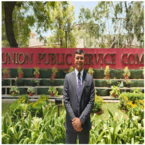
“Learning from Failures, Limited Resources and Consistent Practice: The Keys to Success”
CSC: Heartiest congratulations on your success from Civil Services Chronicle. Please tell us something about yourself.
Raj Ujjwal: Thank you. I belong to Deoghar district in Jharkhand. I graduated from Satyawati College (Evening), University of Delhi, and for nearly a year, I have been working as a Junior Statistical Officer in the Ministry of Statistics and Programme Implementation at Cuttack, Odisha.
My hobbies include reading books, playing chess, practising calisthenics and learning new languages. These interests have helped me become more disciplined, adaptable and mentally resilient.
I consider curiosity, discipline and perseverance to be my three greatest strengths. Throughout this long journey of preparation, these qualities helped me continue learning and moving forward despite setbacks.
CSC: How did your interest in the uniformed services and CAPF develop?
Raj Ujjwal: My NCC experience inspired me to pursue a career in the uniformed services. My early exposure to the SSB environment in my mother’s hometown also contributed to this aspiration.
I cleared CDS and AFCAT multiple times, but could not succeed in the SSB. In 2023, I appeared for the CAPF examination for the first time but could not clear the written stage. In CAPF 2024, I cleared the written examination with good marks, which made me realise that the examination was well within my reach. However, an injury during the PET ended that attempt.
Subsequently, I joined as a JSO through SSC CGL and finally secured AIR 37 in my third CAPF attempt.
CSC: What were the shortcomings in your initial preparation, and how did you overcome them?
Raj Ujjwal: Initially, my preparation lacked direction, and I found myself overwhelmed by too many resources. Another major challenge was my inability to complete Paper II within the stipulated time, which significantly affected my performance in one of my attempts.
Thereafter, I sought genuine feedback from friends and started practising essays, arguments and report writing regularly. Gradually, I reduced the time taken to write answers while ensuring that the quality did not suffer.
For my third attempt, I decided to stick to limited and reliable sources along with my own notes.
CSC: What was your overall preparation strategy?
Raj Ujjwal: The key pillars of my strategy were conceptual clarity, strong fundamentals, regular revision, analysis of Previous Years’ Questions (PYQs), daily newspaper reading and consistent adherence to a study schedule.
The three factors that made my preparation most effective were consistent effort, PYQ analysis and sticking to limited resources.
I also realised that instead of simply replicating another aspirant’s strategy, one should devise an approach suited to one’s own circumstances, strengths and weaknesses.
CSC: What was your strategy for Paper I and Paper II?
Raj Ujjwal: For Paper I, I focused on strengthening my conceptual understanding of key areas such as Science, Geography, Mathematics, Polity and Economy. I then used PYQs to identify weaker areas and revised them repeatedly.
For Paper II, regular newspaper reading and Civil Services Chronicle Magazine helped me not only with content but also with understanding how arguments and answers should be structured. I regularly practised essays, arguments and report writing.
Before writing an essay, I would brainstorm, frame the structure and then begin writing. Gradually, I aimed to complete an essay in approximately 12 minutes.
For précis writing, I first tried to understand the entire passage and then condensed it to approximately one-third of its original length in my own words. For grammar, I focused on conceptual clarity and practised PYQs.
CSC: How important were PYQs, and what study resources did you follow?
Raj Ujjwal: I solved more than 5,000 PYQs from examinations such as CAPF, CDS and CSE. This helped me understand the demands of the examination and identify areas where my conceptual understanding was weak.
My preparation strategy was heavily anchored in foundational texts and standard references. For Polity, I relied exclusively on M. Laxmikanth. My approach to Science, Geography, Economy, and History was built on a strong foundation of NCERTs, ranging from Class 6 to 12 depending on the subject's requirements. Specifically for Science, I supplemented the core curriculum with selected higher-level topics from Classes 11 and 12. Finally, for Mathematics, I adopted a practice-oriented approach focused on mastering Previous Year Questions (PYQs)."
For current affairs, I followed The Hindu, CAPF Hub’s ‘TitBits’ and Civil Services Chronicle magazine. I tried to connect current developments with static subjects rather than studying them in isolation.
CSC: How did you manage your preparation alongside a full-time job?
Raj Ujjwal: On working days, I generally devoted 3–4 hours to focused study, while on weekends, I studied for around 6–8 hours. I had fixed study slots in the morning and evening. During my commute, I would read the newspaper, revise concepts and occasionally solve PYQs.
I believe working aspirants should closely analyse their daily schedules and identify the time available to them. Instead of trying to study for very long hours on a particular day, consistent and effective utilisation of available time is far more important.
CSC: How did you prepare for the Personality Test?
Raj Ujjwal: I analysed my Detailed Application Form (DAF) thoroughly and tried to explore the ‘why’ behind every possible question. I prepared potential questions and follow-up questions related to my home state, education, profession, hobbies and current affairs. I also used the internet and AI tools such as Gemini and Perplexity for this purpose.
Mock interviews provided an environment similar to the actual UPSC board. My mentors pointed out that I tended to speak a little too fast and needed to revisit the fundamentals of my graduation subjects. I worked on both aspects.
If I did not know the answer to a question, I preferred to admit it honestly rather than bluff. In my view, confidence, effective communication and composure are among the most important qualities expected of an Assistant Commandant.
CSC: What role did ‘The Invisible Helping Hand’ initiative play in your preparation?
Raj Ujjwal: I was associated with Shri Rakesh Nikhaj’s initiative, ‘The Invisible Helping Hand’, for around three months. My friend Nikhil Kumar (AIR 167, CAPF 2024) had recommended it to me.
The initiative provided guidance for the Personality Test, mock interviews and a supportive community of fellow CAPF aspirants. It helped me understand the finer aspects of the interview and the parameters on which a candidate is assessed.
In my opinion, such initiatives are particularly valuable for aspirants who may not be able to afford expensive resources.
CSC: Finally, what message would you like to give to CAPF aspirants?
Raj Ujjwal: Do not run after too many resources and coaching notes. Choose limited sources, revise them repeatedly and make PYQ analysis an integral part of your preparation. Physical activity should also be incorporated into your daily routine.
Having a Plan B is important as well. It can reduce the anxiety associated with the uncertainty of examination results and help you pursue your primary goal with greater peace of mind.
CSC: Thank you, Mr. Raj Ujjwal, for sharing your roadmap to success so candidly. Your story is sure to inspire the next generation of Assistant Commandants.
Topper's Interview
-
Utkarsh Yadav - All India Rank 32 - UPSC Civil Services Examination, 2025
-

Surabhi Yadav - All India Rank 14 - UPSC Civil Services Examination, 2025
-

Mansi Gupta - All India Rank - 78 - UPSC CSE 2025
-

Shambhavi Tiwari - All India Rank - 46 - UPSC CSE 2025
-
Deeksha Chourasiya - All India Rank - 44 - UPSC Civil Services Examination 2025
-
DIKSHA RAI - All India Rank 40 - UPSC Civil Services Examination 2025
-
RUPAL JAISWAL - All India Rank 43 - UPSC Civil Services Examination, 2025
-
Sakshi Jain - All India Rank-13th - UPSC Civil Services Examination 2025
-
Ananya Sharma - All India Rank – 37 - UPSC Civil Services Examination 2025
-

Zinnia Aurora - All India Rank – 6th - UPSC Civil Services Examination, 2025
