
Interview - Utkarsh Yadav
Utkarsh Yadav
UPSC Civil Services Examination, 2025
(All India Rank 32AIR)
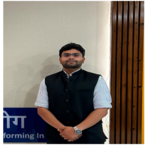
CSC: Heartiest congratulations to you from Civil Services Chronicle for your success. How are you feeling?
Utkarsh: Thank you so much for the kind wishes. I feel very happy about the fact that the exam cycle is finally over and am looking forward to beginning my journey in the civil services.
CSC: What was your inspiration for becoming an IAS officer? To whom do you give credit for your success? What was the role of your family and others (teachers, friends) in your preparation and success?
Utkarsh: My inspiration to join civil services came from an accumulation of various factors such as my family, my native place and the experiences I have had in my journey. It was the sum total of these factors that steered me towards the idea of becoming a civil servant and work for the people.
I give the credit of this success to my parents, the Almighty, my teachers and my friends who have been there for me as a robust support system throughout my journey. It was they who stood by me in my low phases and kept giving me the power to keep pushing. They have always given me the belief that I could do it. Their presence gave me the comfort and security to keep pushing my limits and without worrying about external pressures or other distractions.
CSC: What strategy should one follow for preparing for General Studies (Prelims & Mains)? Did you integrate your Prelims and Mains preparation, or were they separate?
Utkarsh: The strategy that one should follow for preparing GS for Prelims and Mains is a three step approach. Firstly, the syllabus and the PYQ trends must be studied to identify the patterns and trends of the paper. Secondly, the sources must be clearly outlined to avoid duplication of efforts and keep the preparation concise. Thirdly, the content must be covered and multiple revisions integrated with tests should be done.
I did an integrated Mains and Prelims preparation, covering the basic common sources for both of them. However, there is a separate preparation that needs to be followed in each stage, depending on the demand of the paper and syllabus given by the Commission.
CSC: How much time did you devote to each stage-Prelims, Mains, Interview, and Optional? How did you manage your time for both the Prelims and Mains examinations?
Utkarsh: I devoted around four months to dedicated Prelims preparation and around three months to dedicated Mains preparation. My optional preparation went on for around six months and my interview preparation was for about one month.
To manage my time in Prelims and Mains, I set out a targeted approach where I planned micro targets for every day, week and month. I planned my basic coverage and revision targets in a manner that I had buffers to complete my targets and could also revise. During the Prelims preparation, I allocated time slots for solving questions and dedicated specific sessions to answer writing.
CSC: Did you prepare notes? How helpful are they, and what is your advice on note-making?
Utkarsh: Yes, my entire preparation was centred on note-making. Notes helped me to cover the entire syllabus efficiently and multiple rounds of note making also helped me memorise the content effectively.
My advice on note making would be to follow a multiple rounds of note making. Firstly, cover the content from scratch and then begin with shortening of notes. With each iteration, shorten them further while omitting content already memorized and making a shorter version. This multiple round will help you to have really concise notes of the entire content.
CSC: What was your optional subject? What was the basis for selecting it? What strategy should one follow for preparation?
Utkarsh: My optional was Geography. The basis of selecting this optional was that I have a background in geography as my graduation subject and basic familiarity with it. I always felt comfortable reading the subject and could process information effectively.
To prepare for optional, one should cover the basic sources to prepare the syllabus content. Once the notes are done, the PYQs should be written and value addition must be done using various sources and technology like AI. After this, the answer writing and tests should be prepared.
CSC: What was your preparation strategy and booklist for Ethics (Paper-IV)?
Utkarsh: My strategy for preparation of Ethics paper IV was a keyword-centric approach. I took all the keywords mentioned in the syllabus and prepared notes on each one of them. I then did the value addition with real life examples and other enrichment using AI. To tackle the case studies, I studied the toppers’ copies and prepared the broad themes of case studies. I did not refer to any books but used a lot of online resources.
CSC: Tell us about your preparation for the Essay paper.
Utkarsh: My preparation for the essay paper was pivoted on maintaining a natural flow and expression. I analyzed the previous year papers and categorised the topics into various themes. I then read the toppers’ essay copies to understand the methods and then prepared some enriched content using AI and toppers’ copies. I focused a lot on brainstorming a topic before actually writing an essay and used a lot of connectors to link various paragraphs.
CSC: What was your style of writing in the exam? How was it distinct from the general writing style? How did you develop it?
Utkarsh: My style of writing in the paper mainly revolved around following a fixed structure in all the questions. I devised a certain checklist for writing an answer that involved an introduction, a conclusion, addressing the demand of the question through subheadings and giving appropriate diagrams and schematics. I stuck to this checklist in every question.
I prepared this style of writing by practicing a lot of previous year questions in a strict time limit and using self-evaluation to improve my answers progressively.
CSC: How did you prepare for the interview? What types of questions were asked? Did you answer them all? Was there any specific area the board emphasized?
Utkarsh: To prepare for my interview, I studied my DAF very closely and prepared the technical terms using AI. I then took help from AI tools to generate a questionnaire and prepared some answers. My interview simulation happened with my peers conducting a lot of one-to-one sessions along with a few mocks. I also practiced the breathing techniques to stay calm and take pauses before answering.
CSC: What is the importance of coaching in Civil Services preparation?
Utkarsh: Although I haven’t attended the foundation course for GS anywhere, I believe that coaching institutions do help in providing the required concise study material and the faculties help the students to understand the subjects and guide them wherever they want help. Using the appropriate guidance and resources, one can streamline the preparation.
CSC: What was the role of Civil Services Chronicle in your success?
Utkarsh: Civil Services Chronicle magazine for civil services has a long-standing legacy as it has been guiding the aspirants with its reliable and credible content. The regular editions have helped in the exam preparation especially in the current affairs.
CSC: What were your primary sources of preparation? Which books, magazines, newspapers, and online sources did you use?
Utkarsh: My sources of preparation have been very limited, primarily relying on the standard books such as the NCERTs and authentic sources like the Bare Act of the Constitution. Apart from them, I have used diversified sources such as toppers’ notes, the current affairs compilations and AI tools to summarise bulky books. For GS, I prepared topic-wise notes using these sources and for optional, I took the foundation notes as the base notes and did value addition to it. In addition to this, I also took help from the toppers’ copies.
CSC: We are deeply grateful for your time and for the wisdom you've shared with our valuable readers through this interview. We wish you a distinguished career in the Indian Administrative Service.
Topper's Interview
-
Raj Ujjwal - All India Rank 37 - Assistant Commandant Examination 2025
-
Surabhi Yadav - All India Rank 14 - UPSC Civil Services Examination, 2025
-

Mansi Gupta - All India Rank - 78 - UPSC CSE 2025
-

Shambhavi Tiwari - All India Rank - 46 - UPSC CSE 2025
-
Deeksha Chourasiya - All India Rank - 44 - UPSC Civil Services Examination 2025
-
DIKSHA RAI - All India Rank 40 - UPSC Civil Services Examination 2025
-
RUPAL JAISWAL - All India Rank 43 - UPSC Civil Services Examination, 2025
-
Sakshi Jain - All India Rank-13th - UPSC Civil Services Examination 2025
-
Ananya Sharma - All India Rank – 37 - UPSC Civil Services Examination 2025
-

Zinnia Aurora - All India Rank – 6th - UPSC Civil Services Examination, 2025