
A constructive attitude is crucial for public servants dealing with complex challenges and high-pressure situations. What factors contribute to developing such an attitude in individuals?
Answer: A constructive attitude reflects a solution-oriented, optimistic, and resilient mindset that enables individuals — especially public servants — to face adversity without succumbing to despair or defeatism. It reinforces ethical conduct, emotional balance, and long-term institutional trust in governance.
Constructive Attitude is Essential for Public Servants
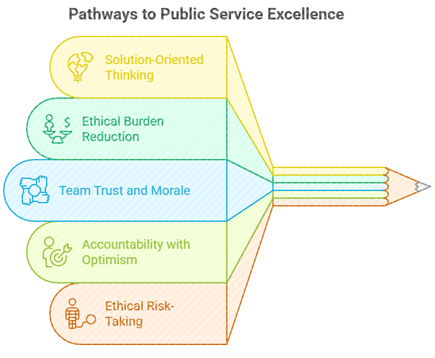
A constructive attitude:
- Enables solution-oriented thinking
- Reduces ethical burden and emotional stress
- Builds trust and morale within teams
- Encourages accountability with optimism
- Supports ethical risk-taking
Factors Contributing to a Constructive Attitude
- Family and Early Socialization: Values like empathy, patience, and cooperation ....
Do You Want to Read More?
Subscribe Now
Take Annual Subscription and get the following Advantage
The annual members of the Civil Services Chronicle can read the monthly content of the magazine as well as the Chronicle magazine archives.
Readers can study all the material before the last six months of the Civil Services Chronicle monthly issue in the form of Chronicle magazine archives.
Related Content
- 1 Political apathy among citizens weakens democratic institutions and accountability. Discuss the ethical dimensions of political apathy and suggest measures to promote responsible civic participation.
- 2 “The consequences of moral actions may not be immediate, but they are enduring.” Explain this statement with examples.
- 3 “Punishing corruption without addressing the mindset behind it is a short-term fix.” How can a shift in attitudes among public servants and citizens contribute to long-term anti-corruption efforts?
- 4 Reports of deepfake videos and AI-generated misinformation are steadily rising in India, often resulting in reputational harm and mental distress. In light of such developments, what are the ethical dimensions of human behaviour in the digital world? How can families and educational institutions contribute to fostering digital responsibility and empathy among youth?
- 5 The Government of India recently stated that “The end of Left-Wing Extremism has begun.” In this context, examine the broader strategy behind India’s special campaign to eliminate Naxalism by 2026.
- 6 How can the AgriStack initiative contribute to increasing agricultural productivity and income in India? What concerns have emerged regarding its implementation?
- 7 “India’s air defence system stands as a multi-layered, technologically sophisticated framework that shields the nation from diverse aerial threats.” Explain.
- 8 "Emerging technologies offer transformative capabilities in border management, but also pose operational challenges." Analyze this statement in the context of India’s efforts to modernize its border infrastructure and surveillance capabilities.
- 9 What is Flexible Inflation Targeting (FIT)? In the context of India’s emerging macroeconomic scenario, evaluate its effectiveness in achieving its stated objectives.
- 10 Highlight the constitutional and legal provisions governing the Delimitation Commission in India and discuss why the upcoming delimitation exercise has raised concerns in southern states.