
Question : How does the climate change affect the process of desertification in India?
(2015)
Answer : Extreme form of land degradation in semi-arid and sub-humid areas is known as desertification.
Desertification can be due to various reasons such as,
soil erosion,
All these activities have increased the desert area and resulted in more desertification. Although climate change has many indirect bearings ....
Question : Outline the Government of India’s strategies of conservation of the western Ghats.
(2015)
Answer : Western Ghats and Eastern Ghats are named according to the cardinals locations east and west. The Ghats are bounded by Deccan/Peninsular plateaufrom the landward side and by coastal plains from the seaward ride.
Western Ghats are comparatively thin and narrow as compared to the Eastern Ghats.
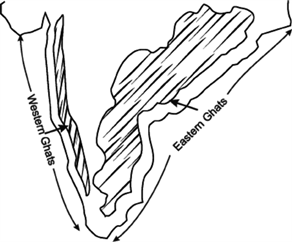
Western Ghats or sahyadris run parallel to the western coast for about 1600 km in the North South direction ....
Question : Explain the concept of ‘Make in India’ and indicate the essential inputs for its success.
(2014)
Answer : “Make in India” is both an economic and political economy umbrella for creating a consensus for and making the vital policy and institutional reforms that can accelerate the growth of manufacturing and higher quality jobs in this sector. It can also stimulate the creation of employment opportunities in services needed for manufacturing, agriculture and construction.
One of the greatest obstacles to “making in India” is the jungle of laws, rules, bureaucratic controls and procedures. As ....
Question : Enumerate the basic indicators of development and explain their application in identification of the spatial diversity in development in India.
(2013)
Answer : The basic indicators of development can be enumerated in the form of social and economic Indicators, such as 1. Gross Domestic Product per capita 2. Life Expectancy 3. Literacy Rates 4. Measures of Poverty 5. Demographic Indicators like Population Growth Rate and Infant Mortality Rate.
The spatial diversity of development in India is a manifestation of diversity in various indicators of development across the country.
For instance, states with high values of Human Development indicators like Kerala, ....
Question : Factors affecting innovation diffusion.
(2012)
Answer : If production rises or rate of production increases due to use of new kinds of resources or new ways of usage of old resources in production, then it is known as innovation. Diffusion of innovation is helpful in speeding up economic growth, reducing future costs, increasing production rate etc. Innovation leads to high standards of quality and skills. Following are the factors responsible for innovation diffusion:
Question : Identify Tsunami affected areas and give their management problems in India.
(2012)
Answer : Tsunamis are waves generated due to change in ocean basin because of underwater subsidence, landslide or volcanic eruption. Tsunami affected areas in India are mainly coastal areas in the East Coast and Island groups in Indian Ocean. Tsunamis are deep waves and are full of energy. They cause loss of life and property.
Management is necessary for pre-Tsunami preparation and post-tsunami events. So that impact of disaster can be reduced. There are many problems in management ....
Question : Discuss the impact of globalization on India’s industry and agriculture sectors.
(2009)
Answer : Globalization means integrating our economy with the world economy. Because of this globalization our economy has become interdependent on global economy. This inter-dependence takes place at various levels such as many producers from outside the country can sell their goods and services in India. We can also produce goods and services and sell them in other countries. Globalization facilitates to those who have capital to establish enterprises in India, produce goods for sale within the ....
Question : What are the causes and consequences of environmental degradation in India’s Industrial areas? Give specific examples.
(2009)
Answer : The environment refers to the sum total of conditions which surround us at a given point of space and time. In other words environment is the totality of all physical, social and biological factors that comprise the natural and man made surroundings. The basic structure of the environment can be divided into two broad types eg. physical environment and biotic environment. The physical environment represents three basic realms of the earth i.e. lithosphere (land), the ....
Question : Discuss the environmental problems of India in the context of rapid economic development and population growth.
(2007)
Answer : The Stockholm Summit, the first ever on environment related issues, clearly established that the poverty and development are biggest polluters. This statement is still very relevant in the context of environmental problems of India.
India witnessed a slow progress of Industry driven economic development in the first four decades of Independence. This pace has risen suddenly in the post reform era during early nineties. This time the country is witnessing a boom in the industrialisation.
The manufacturing ....
Question : Evaluate the concept of sustainable growth and development.
(2004)
Answer : Development is a process about improving the well-being of people and Sustainable Development sustains this process. It is a development that aims at efficient utilisation of resources without depleting it irresversibly.
The concept of sustainable growth and development is very broad and incorporates in its fold all the ingredients of public welfare. The general principle of sustainable development adopted by the World Commission on Environment and Development—that “Current Generations should meet their needs without compromising the ....
Question : Elucidate the role of tribal development blocks in development of tribal areas.
(2002)
Answer : Constitution of tribal development blocks was started in 1980’s, on the recommendation of Au Sui Committee. The committee recommended two different strategies.
(i)TSP: Tribal Sub-Plan for those area, where the tribals were in majority or their population was more than 5000.
(ii)MADA :Marginal Area Development Agency for those areas where the tribals were less numerous in strength or less than 5000 in number.
This programme was a target plan. It targeted directly the mass tribal population and their ....
Question : Explain the causes, impacts and remedial measures of earthquake disaster.
(2002)
Answer : An earthquake is a vibration or oscillation of the surface of the earth caused by a transient disturbance of the elastic or gravitational equillibrium of the rocks at or beneath the surface.
Earthquakes are caused mainly due to dis-equillibrium in any part of the crust of the earth. This disequillibrium can be attributed to many causes.
(i)Volcancity is one such major cause. In fact, valcancity and seismic events are so intimately related to each other that they ....
Question : In what way the language, religion and tradition can form the basis of cultural regionalisation of India?
(2002)
Answer : Region is an area of homogeneity with isotropic surface and common attributes. Hetrogeneity will be automatically found accross the boundary of such region. But such boundaries are not watertight compartments. They are only transitional. Thus, their demarcation is a problem in geographical studies. Still, some commonality on macro level and maso level are taken and micro level hetrogenities are avoided to demarcate a region.
A geographical region or a physical region is bound to be different ....
Question : Explain the geographical characteristics of the regional distribution of earthquakes in India.
(2001)
Answer : Earthquakes are generally caused by sudden release of pressure along active faults and in area of volcanic activity. The earthquakes occuring in India is rlated to the former as volcanic activity is almost. The earthquakes occuring in India is related to the former as volcanic activity is almost no–existent in this region. Now the occurrence of earthquakes in India can be satisfactorily explained according to the theory of Plate Tectonoes. There vibrations in the earth’s ....
Question : Examine the national Forest Policy of India.
(2000)
Answer : India is one of the member of small elite group which has forest policy in operation since 1894. In 1952 and 1988 revisions where made in this forest policy. The national forest policy of 1952 recommended that the country should aim at a coverage of one-third of the total land area under forests. It has suggested the extention of tree lands on river, canal, banks and in such areas which are not suitable for cultivation.
The ....
Question : Examine the nature and extent of environmental degradation in the Himalayas.
(1998)
Answer : The Himalayas are an example of a fragile eco-system. Their significance in terms of their soil-forming, water providing and bio-diversity attributes has been discussed under Indian Physiography. The Himalayas also face environmental degration of various kinds.
Question : Evaluate the nature of ecological problems in India and suggest measures for their management.
(1997)
Answer : Environmental problems in India can be classified into two broad categories:
(a) those arising as negative effects of the very process of development; and
(b) those arising from conditions of poverty and underdevelopment.
The first category has to do with the impact of efforts to achieve rapid economic growth and development and continuing presures of demand generated by those sections of society who are economically more advanced and impose great strains on the supply of natural resources. Poorly ....
Question : Critically examine the relationship between deforestation and environmental degradation with specific examples from any one region in India.
(1995)
Answer : Forests have a wide ranging ecological significance. Deforstation introduces distortions in man-nature intrection and results into degradation of environment. The Himalayan case study statisfactorily proves this point.
Himalayan case study: In Himalayan region forests were considered to be lifelines of the economy and social life. It provides food,fuel fodder to human population, rich shrubs for medicinal uses and adds rich humus to the soil. The roots of trees have capacity to hold water and soil. Thus ....
