
Question : Examine the forest resources of India and explain the principles of conservation which could be applied to improve the forest wealth of India.
(1994)
Answer : Forests are precious national resource which not only play significant role in national economy but help in pollution control and maintaining ecological balance. These offer a number of direct and indirect advantages which have been realised since time immemorial.
Indian forests contain over 5000 species of wood of which about 450 are commercially valuable. This includes both hard and soft wood. Hard woods are mostly provided by trees belonging to tropical and sub-tropical forets, i.e. sal, ....
Question : Account for geographical distribution of groundwater resources of India. How serious is its depletion in recent decades?
(2015)
Answer : Water present in the pore spaces of permeable rock, between the surfaces is known as groundwater. In India, 30-40 million. hectares is ground water resource. Distribution of groundwater reserves:
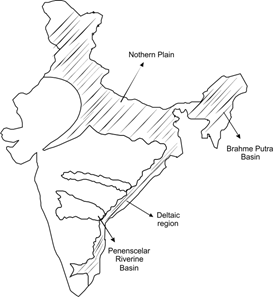
Distribution of groundwater reserves among rivers-
Ganga ....
Question : How does natural vegetation affects the formation of in-situ soils?
(2015)
Answer : Natural vegetation helps in in-situ formation of soil in many ways. First, the roots of natural vegetation penetrates and thereby it helps in breaking up of original/parent rock which forms the small pebbles or smaller particles. As this process continues, gradually formation of zone C, B, A takes place.
Second, roots of natural vegetation sometimes provide nutrition to the soil and make the soil porous thereby facilitating moisture holding capacity in the soil: For example nitrogen ....
Question : Suggest the measures of wild-life conservation with reference to extinction of rare species.
(2014)
Answer : India is home to different types of animals, birds and fishes which include some important farm animals like goats, poultry, cows, buffaloes, pigs etc. The country is also a habitat for wild animals like Bengal tigers, deer, wolves, pythons, Indian lions, bears, snakes, monkeys, many types of bison, Asian elephants and antelope species. India is one of the mega diverse countries out of a total of seventeen mega diverse countries in the world. These seventeen ....
Question : Location of thermal power plants and coal fields in India are not mutually conducive. Analyse.
(2014)
Answer : The coal-fired power plants in India are facing acute shortage of coal. This may lead to sharp drop in coal-fired power generation if the supply scenario fails to improve. The power shortage in India has reached such a situation that of the 142,647 MW of peak demand only 137,352 MW was met leaving an unmet gap of 5,295 MW.
The major reason for this low stock position is the lower than planned supply of thermal coal ....
Question : Delineate the coalfields of India and mention their distinctive features.
(2013)
Answer : The Coal found in India belongs to two geological periods: the Gondwana and the Tertiary, the former accounting for overwhelming greater proportions of both the reserves and production. In India 99% of our coal production comes from the Gondwana coals which are found in three geological units: Raniganj Formation from upper Permian and Barakar and Karharbari Formations from lower Permian. The largest part of production (43 %) comes from the coalfields of Jharkhand, Odisha and ....
Question : Delineate the mineral belts of India and mention their distinctive features
(2012)
Answer : Mineral distribution in India is not uniform. Maximum minerals are found in Peninsular India. Important mineral rich states are Jharkhand, Odisha, M.P., Chhattisgarh, and Rajasthan. Iron ore deposits are found in archean shells inOdisha, Jharkhand, Chhattisgarh, M.P., Karnataka, Tamil Nadu. Mangenese ore is found in Odisha, M.P., Karnataka, Maharashtra. Bauxite is found in Jharkhand, Bihar, and Chhattisgarh. Kyanite is found in Jharkhand, Maharashtra and Ilmenite in Kerala and Odisha. Following regions can be demarcated for ....
Question : Identify the important biotic-resource regions of India. Highlight in brief the problems and remedial measures of biotic resource conservation in India.
(2004)
Answer : Biotic resources refer to flora and fauna of a country and India has no dearth of these resources. With two per cent of the world’s land, the country has about five per cent of living resources. It has therefore, been designated as one of the 12 megadiversity states in the world. India is said to have about 46,000 species of plants (7% of the world’s total) ranging from thorny bushes to evergreen forests. Indian fauna ....
Question : Critically examine the metalliferous mineral resources of India with particular reference to their present and future demands.
(1996)
Answer : Metalliferous mineralas form an important section of mining activity in India and provide solid base to metallurgical industries in the country. Metalliferous minerals are those minerals which have iron content. Iron ore, manganese, chromite, tungsten, nickel, cobalt, vanadium etc. are important example of metalliferous minerals.
Iron Ore: India isone of the richest countries of the world in iron ore deposits. Iron ore is the back bone of modern civilization. A good quality iron-ore type, known as ....