
Question : Internal structure of an Indian city.
(1994)
Answer : Urban morphology deals with the physical layout and internal functional structure of an urban area. Indian towns, on the basis of their morphological characteristics, may be classified under two broad categories:
1.Indegenous: These have fully Indian characteristics, such towns are mainly distributed in the areas of northern plains, desert borderlands and Deccan Peninsula and exhibit impact of south-west Asian (Islamic) culture in the form of narrow winding streets.
2.European Type: These include cantonments, civil lines, railway colonies ....
Question : Bring out the salient characteristics of Indian urbanisation with suitable examples.
(1994)
Answer : Urbanisation is a socio-economic process by which an increasing proportion of the population of an area becomes concentrated into the towns and cities. It is the most significant phenomenon of the 20th century which has almost affected all aspects of the national life in India.
Follwing are the salient characteristics of Indian urbanisation:
Question : Distinguishing features of an urban slum and its position in metropolitan area.
(1993)
Answer : 'A slum connotes an extreme condition of blight in which the housing is so unfit as to constitute a menace to the health and morals of the community'. It is a residential area where the dwellings by reason of dilapidation, over crowding, faulty arrangements of design, lack of ventilation, light and sanitary facilities or any combination of factors are deterimental to safety, health and morals. Slums are one or two-room hutments mostly occupying government and ....
Question : Mono functional towns are economically vulnerable. Discuss.
(2015)
Answer : Functionality of town is basically determined by the type of function or sector it is engaged in. A criterion for monofunctinal towns is if 40% or more population is engaged in a single sector of economy.
These towns are particularly economically vulnerable because: one, viability of the particular single base industry or sector.
Second, if the sector or industry is not performing well then economy of these town will go down or will not perform well.
Third, if ....
Question : Discuss the trends in emigration focusing on its major thrust.
(2014)
Answer : India has one of the world’s most diverse and complex migration histories. Since the 19th century, ethnic Indians have established communities on every continent as well as on islands in the Caribbean and the Pacific and Indian oceans.
The composition of flows has evolved over timefrom mainly indentured labor in far-flung colonies to postwar labor for British industry to high-skilled professionals in North America and low-skilled workers in the Middle East.
In addition, ethnic Indians in ....
Question : How has an inappropriate urban land use policy accounted for undesirable development in and around metropolitan cities?
(2014)
Answer : As the urban population grows, the necessity for land and contruction to give shelter to the population increases correspondingly. But land procurement by insufficient and partial policies, is a very important problem for the development of our cities.
Insufficient land availability leads to bottlenecks in infrastructure development rise of squatter settlements in marginalised locations and problem of location for business entities. therefore it is pertinent to have a healthy urban policy for proper land-use planning.
To make ....
Question : Demographic Dividend and its implications on Indian socio-economic development.
(2013)
Answer : In India, 27.5% of the population belongs to 15-29 years age group while 41.3% are in 13-35 years age group. These age groups are termed as “Demographic Dividend”. Though loosely defined, it integrates all the people within the age of 15 to 49. This can provide fantastic opportunity for India to capitalize on its assets.
Implications on Indian socio-economic development:
Question : Discuss the objectives of ‘Vision 2020’ in creation of viable village complex in India for ‘Inclusive Rural Development’ programme.
(2013)
Answer : Inclusive rural development means focusing on all those aspects of development which provide enabling framework for growth of all sections of the society in all sphere. It mainly emphasizes on:
Question : Define slums and explain their problems.
(2013)
Answer : A “slum” is the compact settlement of at least 20 households with collection of poorly built tenements, mostly of temporary nature, crowded together usually with inadequate sanitary and drinking water facilities in unhygienic conditions.
The census defines a slum as “residential areas where dwellings are unfit for human habitation” because they are dilapidated, cramped, poorly ventilated, unclean, or “any combination of these factors which are detrimental to the safety and health” Roughly 1.37 crore households, ....
Question : Evaluate the population policy of India and examine its relevance to the nation’s population control.
(2012)
Answer : India is the first country which formally launched family planning programme in 1952. But real analysis only started in 3rd Five Year Plan. Short term target in fixed time frame were set up to control the growth rate of population. In 4th Plan, birth rate was targeted to be lowered to 23 from 39 by 1978-79 through small family norms. 5th Plan integrated family planning services with welfare schemes. During Emergency, programmes such as forcedvasectomy ....
Question : “There is no sharp divide where an urban settlement stops and rural areas begins”. Analyse the statement with reference to the sprawl of Indian cities.
(2009)
Answer : There is no sharp divide between where an urban settlement stops and rural area begins. For this kind of urban sprawl, rural-urban fringe concept has been given by Pyror. R.J. Pyror has postulated this concept in 1968. According to him it is a zone of transition between the continuously built up urban areas and the suburban areas of the central city and the rural hinterland. The rural-urban fringe has also been defined as the area ....
Question : State the geographical factors which influence rural house types in India
(2009)
Answer : Villages in India, where the concept of planned rural settlements does not seem to exist, are a sort of natural growth in their physical and cultural settings. Though they do not possess well defined shapes and a distinct internal plan, there is considerable organization, both in the internal structure and external profile of villages which is very closely related to the attributes of the site and its cultural setting.
However the geographical factors which determine the ....
Question : Explain the Morphology of Indian cities in the background existing Morphological Models.
(2006)
Answer : Urban morphology deals with the physical layout and internal function structure of an urban area. Here ‘physical layout’means urban structure and may be termed as internal geography of the city. Similarly, functional morphology may be interchanged with urban land use. Various theories have been advanced by urban geographers to analyse the morphology of urban centre which are follows:
Question : How do slums develop? Give concrete suggestion for their improvement.
(2004)
Answer : A slum denotes a residential area where the dwellings by reason of dilapidation, overcrowding, faulty arrangement of design, lack of ventilation, light and sanitary facilities or any combination of factors are detrimental to safety, health and morals. According to the estimates of Town and Country Planning Organization, about 21.2% of India’s urban population lives in slums. This proportion is even higher in metropolitan cities like Kolkata, Mumbai, etc.
The origin and development of slums in the ....
Question : Discuss the census definition of urban areas in India
(2003)
Answer : The definition of urban areas presents many conceptual and methodological problems. It is generally accepted that a single criterion is not enough to define an urban place. Census of urban settlement was started in 1891, which was criticised as its definition lacked a precise population size.
Subsequently, 1901 census defined towns as (a) every municipality, (b) all civil lines not included within the municipal limits, (c) every contonment and (d) every other collection of houses inhabited ....
Question : Hierarchial pattern of Indian towns.
(1999)
Answer : A hierarchy is a system with grades of status, ranked one above the other in a series, with the ranking usually reflecting a sort of inter-dependence. The hierarchial pattern of Indian towns can be analysed in the following two ways:
1.Structural Pattern: An important aspects of urbanisation all over the world is the uneven pattern of development of small towns and big cities within the system. Every urban system is characterized by the presence of a ....
Question : Discuss the environmental impact of the growth of slums in Indian cities.
(1999)
Answer : A slum is a residential area where the dwellings by reason of dilapidation over-crowding, faulty arrangement of design, Lack of ventilation, light and sanitary facilities and any combination of factors are detrimental to safety health and morals. It connotes a extreme condition of light so as to constitute a menace to the health and morals of the community.
Slums are peculiar to the urban areas and are known as shanty towns, squatter settlements or Jhuggi-Jhopris. The ....
Question : Explain with suitable examples and sketch-maps, the distribution of various patterns of rural settlements in India.
(1999)
Answer : The spatial organisation of houses in a village defines its pattern, i.e. it is the relationship between one house or building to another. Here site attributes along with the layout of the land, configuration of roads and streets play decisive role.
The term 'pattern of settlement' deals with compact and semi-compact settlements only as each of the dispersed settlements has its own shape. The rural settlements have different shapes and sizes. Actually the pattern of rural ....
Question : Discuss the gegoraphical control of rural settlement patterns in India.
(1998)
Answer : The spatial organization of houses in a village defines its pattern, i.e. it is the relationship between one house or building to another Geographical controls such as site attributes, terrain characteristics, layout of the land, along with the configuration of roads and streets play a decisive role in determining rural settlement patterns.
Such geographical controls deal with compact and semi compact settlement only as each of the dispersed settlements has its own shape. The pattern of ....
Question : Discuss the concept of city region and referring to Indian cities, examine critically functional indicators used for delimiting the city region.
(1998)
Answer : A city and its surrounding areas are not independent of each other rather they are intricately related with each other. Together they constitute a unified functional region. The fact is that the city and the countryside are mutually interdependent and this relationship covers a wide range of physical, social and economic interactions.
Thus each city wields some influence upon the area surrounding it. The term city region is used to denote the influence of the urban ....
Question : Examine the census concept of urban areas in India.
(1997)
Answer : The term 'urban' as opposed to rural, is related to towns or cities, urban settlement is a large nucleated settlement in which the majority of the employed inhabitants are engaged in non-agricultural activities. Urban areas may be defined by national governments according to different criteria; for example, size, population density, occupation of the people, and type of local government. The census of India until 1951 defined an urban settlement. This defination was modified in 1971 ....
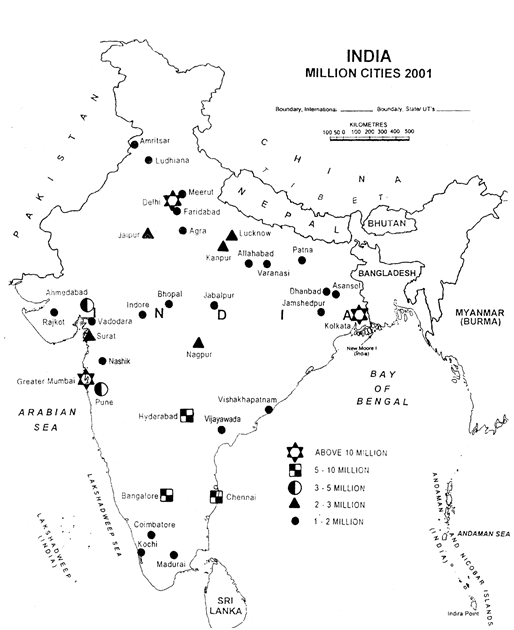
Question : Name the million cities of India according to 1991 census and critically examine the factors for unprecedented growth in their population in the last 40 years.
(1996)
Answer : Metropolis meaning mother city, is a large city which serves as a regional capital. In India a city having one million or more population is called metropolis. According to 1981 census there were 12 metropolitan cities in the country which increased to 23 in 1991 census. These include:
1. Mumbai, 2. Kolkata, 3. Delhi, 4. Chennai, 5. Hyderabad, 6. Bangalore, 7. Ahmedabad, 8. Pune, 9. Kanpur, 10. Lucknow, 11. Nagpur, 12. Surat, 13. Jaipur, 14. Choimbatore, ....
Question : Land use characteristics of the rural-urban fringe in India.
(1995)
Answer : The rural urban fringe is a zone or frontier of discontinuity between city and country in which rural and urbanlanduse are intermixed. The fringe is defined in relation to the city and exists in the agricultural hinterland where landuse is changing.
The fringe consists of an inner fringe which is characterised by land in an advanced stage of trasition from rural to urban landuse. The second area in the fringe is the outer fringe which is ....
