
Question : Elucidate the population density types in India.
(1994)
Answer : Three types of population density (at the district level) may be recognised in India:
High Density Type: There are 254 districts in the country which have a density of more than 400 pesons per sq. km. The high density areas are confined to the traditional ....
Question : Ellucidate the current population policy of India and comment on its effectiveness.
(1993)
Answer : The New Population Policy was announced in 2000. It has special focus on health and education and envisages the target of stable population by 2045 A.D. The poolicy includes freezing of Lok Sabha seats at current level of 547 till 2026, compulsory registration of marriage and pregnancy, alongwith birth and death, cash incentives for compliance with requirements regarding antenatal check up, institutional delivery by a trained birth attendent, increasing the number of health workers, improve ....
Question : "India presents an example of unity in diversity". Elucidate this statement in the context of India's physical and human aspects.
(1993)
Answer : Although with its well marked natural boundaries India is a geograpical entity but its vast size and large extent have fostered variegated characteristics in its physical as well as cultural landscape. It is because of this diversity that the term 'sub-continent' has often been used by some foreign scholars to foment regionalism and divisive forces within the country.
The physical landscape of India is of varied nature—rugged mountains with sharp, pinnacled peaks and steep sided valleys ....
Question : Discuss the social and spatial ramifications of increasing longevity.
(2015)
Answer : Longevity refers to the life expectancy. Increasing longevity though is seen as a sign of development but it has its ramifications too. Social ramificationscan be:
Question : Age-Sex pyramid is representative of the history of a region. Explain.
(2015)
Answer : Age sex pyramid represents the number of population both male and female living in a particular area taken for study.
Generally on left half male population is represented and on right female population. Various elements that can be depicted from age sex pyramid are: first, each level of pyramid reflects the age group.
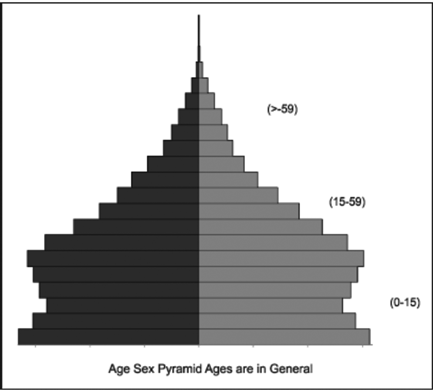
As shown in the fig the lowest part generally represents the young ....
Question : Highlight the implications of declining child sex ratio in India.
(2014)
Answer : A continuously declining sex ratio has many potentially serious consequences. Although there are no historical model by which to learn about the implications of a lack of women relative to men, one fairly obvious social consequence is that there are not enough women for men to marry and the institution of mairiage would lost its relevence. This scarcity of brides might lead to the child betrothal and early mairiage (child marriage) to cope up with ....
Question : Describe the impact of linguistic diversity on the development of various regions of India.
(2013)
Answer : India is a country of heterogeneous ethnic and social groups which have their own languages and dialects. This broad linguistic regional identity formed the basis for the formation of Indian states.
According to 1961 census, there were 1652 languages spoken by different sections of the Indian society. Of these, 23 are spoken by 97 % of the country’s population. Indian languages mainly belong to following four linguistic families:
Indo-European family- These languages are spoken by a sizeable ....
Question : Snags in the Food Security Policy of India.
(2013)
Answer : According to the Food and Agriculture Organization (FAO), food security “exists when all people, at all times, have physical and economic access to sufficient, safe and nutritious food to meet their dietary needs and food preferences for an active and healthy life”. However, challenges in providing food security to people are:
Question : Geographical reason for the variation in literacy from state to state in India.
(2012)
Answer : States in India differ from national average in literacy rate. States like Kerala, Mizoram, Tripura, and Goa have literacy rate about 85-93% while states like Bihar, Arunachal Pradesh, Jharkhand, Rajasthan have literacy rate of around 60%.
This variation in literacy is because of geographical, social, economic, and political factors. Geographical factors include agricultural and industrial development level of respective states, unreachability of institutions/schools etc. Poor condition of agricultural factors creates problem of unemployment, and poverty. Similarly, ....
Question : Explain the causes and consequences of migration.
(2007)
Answer : The fire inside stomach, the fire inside society, the fire in the heart to find better avenues of life are prime factors that force a main to migrate. There are both push and pull factors of migration. The push factors working at place of origin are mainly poverty, unemployment, epidemic, strife or disturbance. Whereas, the pull factors working at place of in-migration are mainly better standard of living, more employment opportunities, better or pleasant weather ....
Question : Evaluate the population policy of India and examine its relevance to nation’s population control.
(2004)
Answer : The achivements of India’s population policy in controlling its numbers have been far from satisfactory. First two Five Year Plans based on clinical approach and Third Five Year Plan based on extension approach passed on merely as experimentation periods. Fourth Plan policy became more positive by adopting cafeteria approach which considered family planning as an kingpin of the plan.
The new population policy announced in 2000 is welcome in some respects. It has special focus on ....
Question : Account for the present distributional pattern of population density in India.
(2002)
Answer : The population density of India shows great spatial variation in terms of its distribution pattern. The geographically conducive areas river basins, coastal low lands, flat plateau, and places where water is easily accessible show greater density. The socio cultural fector like religion, urbanisation, history of settlement, etc. have also given birth to islands of very high density within the Indian territory.
The geographically disadvantageous area, sandy, rocky and holly terrains, climatically hazardous areas show low density ....
Question : Elucidate the sex and age structure of the population of India.
(2001)
Answer : Sex structure refers to ratio of population of males to that of females. In India, the sex ratio is calculated on the basis of number of females per thousand males. In India, the sex ratio is not in favour of females. According to the census of 2001, there are 933 females per thousand males in India. The disturbing factor in the sex ratio is its declining trend. Except slight gains in the census years of ....
Question : Analyse the distribution of population in India in the perspective of natural resources and identity the over-populated and under-populated regions in the country.
(1999)
Answer : The distributional pattern and density of population are highly unevenly distributed over the earth surface and same is the case with natural resources. The pressure of population on the resource base and the available technology determined whether the region is over populated or under populated.
In other words the extent to which resources are utilised and the way in which they are used determine whether an area is under-populated or over-populated. A country is said to ....
Question : Discuss the genesis of ethnic and racial diversities in India.
(1999)
Answer : India has been home of humans for thousand of years and therefore the amazing diversity of ethnic and racial characteristics evident in India has its genesis in the manner the sub-continent has been peopled in a process involving a long period of time. According to anthropologists, evidences suggest that emergence of the Homosapiens did not take place within the sub-continents. Streams of migrants with different ethnic or racial backgrounds have entered India at various periods ....
Question : Critically examine the factors affecting the distributional pattern of population in India.
(1997)
Answer : Population is the most potent resource which can alter the entire face of the country, if utilised prudently. With its total population of 1027.01 millions which is 16.7% of the world's total population, India is the second largest country of the world after China.
Unevenness of distribution is an important feature of India's population. Uttar Pradesh alone houses 16.17% of the country's population. The state's population is more than the total population of Japan (in terms ....
