

Toppers Interview
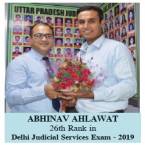
CSC: Achieving top slot in the Judicial Services Examination is no small feet; accept our heartiest congratulations on your splendid success.
Ans: Thank you very much.
CSC: Can you recall the exact moment when you realized the importance of Judicial Services?
Ans: Yes, right from my childhood, I have seen my great grandfather resolving people’s issues, which really inspired me about the role of judge.
CSC: Finally, at what point of time did you make up your mind to make career in ‘Judicial Services’?
Ans : During my LL.B., after interacting with judicial officers.
CSC: You must have read Toppers interviews in newspapers/magazines; what inspired you the most? Any particular success story which influenced your journey to this result?
Ans: Yes, few of them. It helps to motivate in hard times.
CSC: Was JSE a planned decision or your parent’s wish? Did you keep in mind some time frame, for the examination preparation and number of attempts?
Ans: It was my decision to prepare for JSE & my parents really backed me. I was too motivated and never did I think of quitting the preparations.
CSC: About Interview Boards, many candidates have set impressions. Do you consider such thoughts help or hinder one’s performance in Interview?
Ans: I was confident in my own ability. According to me it is better not to set preconceived impressions of the board.
CSC: What was your first step when you were really serious about making a career in Judicial Services?
Ans: When some judgments had direct impact on society, it really made me realize the importance of judiciary.
CSC: Were you confident of your success in this examination and how did you react to this news of your success?
Ans: I was quietly confident about DJS in comparison to other states. I believed I was made out for DJS only.
CSC: In how many attempts have you achieved this success? How do you visualize your preparation/previous attempts?
Ans: This was my 4th attempt. I have appeared in all the MAINS examination.
CSC: Were you preparing for other career opportunities as well while preparing for your ultimate goal i.e. Career in Judicial Services?
Ans: After appearing in many MAINS & not qualifying I started appearing for exams of prosecutor & was selected in Govt. of Haryana.
CSC: What’s important and what’s not? Share your thoughts and opinions.
Ans: Doing MCQ’s is important; it helps in developing the frame of mind, reading judgement to understand the appreciation of facts & Laws.
CSC: ‘Time Management’ - is a key factor while making preparations as well as in writing examination papers. Did you come across such problem during this period? If yes, then how did you manage things?
Ans: Time Management is the key not only while preparing but also during answer writing. I only faced problem when I started working as it becomes very hectic to manage work and studies.
CSC: List some of the Magazines, News papers, Books etc. which you read for ‘General Studies’ preparation.
Ans: Lucent for static G.K., daily newspaper reading, both English & Hindi, live laws for daily legal updates.
CSC: How did you prepare yourself for Interview? When and which Board did you face? How did your interview go on, how much time it lasted and what were the questions asked during the Interview?
Ans.: One should be well aware of things written in the C.V. Questions were related to challenges faced by criminal justice system. I read newspapers & revised my notes,
CSC: According to a recent report published by reputed survey agency, Civil Service Chronicle is the largest read Career & Competition magazine. What is your opinion?
Ans: It is one of the best and oldest magazines, with concise relevant information.
CSC: To whom would you like to give the credit for your success?
Ans: My parents, my wife, my sister, my close friends and of course my mentor Alok Sir and entire Ambition team who supported me and stood with me till the end.
CSC: Any suggestions/advice you would like to give to the future aspirants.
Ans: Know your interest first & develop passion for it. And if you do so then the path is not tough.
CSC: Heartiest congratulations to you from Civil Services Chronicle on your success. How are you feeling about it?
Ans:Thank you so much. I am feeling happy for securing a good rank. I am also relieved that my efforts have paid off and now I am looking forward to an exciting and an impactful career ahead.
CSC: What was your inspiration for becoming an IAS officer?
Ans:I always thought of what I could become, using my capacity to study and learn so as to reach out to the society and do something for the poor, marginalized etc. I got my answer, when I came across the UPSC CSE exam which could enable me to become an IAS officer.
CSC: Whom would you give credit to for your success?
Ans: I would like to thank my parents, my brother and my grandmother with whom I lived and who supported me in my preparation. I would also give credit to my closest friends, teachers and mentors who helped me throughout.
CSC: What was the role of your family and others (teachers, friends) in your preparation and success?
Ans:Family keeps you motivated through your ups and downs during the preparation. Your friends help you douse your stress and worries.
CSC: What were your sources for preparation? Which books, magazines, newspapers and online sources were used by you during the preparation?
Ans:I referred to NCERT - 6-12th Social Sciences as basic books along with standard books on each subject. I also used to read Yojana, Kurukshetra magazine, the Hindu as well as Indian Express. The online sources that I used to refer to were PIB and Rajya Sabha TV.
CSC: How much time did you devote for this exam?
(a)Prelims (b)Mains
(c)Interview(d)Optional
Ans:I integrated my preparation along with college. I prepared my optional subject a year earlier before, giving it 4-5 months. I focused separately on Prelims from February 2018 and prepared for Mains before itself. For interview, I started preparing after the Mains exam.
CSC: How did you manage your time in both Prelims and Mains examinations?
Ans:While attempting Prelims, I used to fill the OMR sheet for questions I was sure about at first, and used to leave the rest for revisiting. For Mains, I took 7-9 minutes to answer each question and did not leave any question unattempted.
CSC: Did you integrate your Prelims and Mains preparation or was it separate?
Ans:I prepared for Prelims and Mains in an integrated manner since most of the subjects overlap. Only when a specific phase of exam came near, I prepared separately on how to approach the questions.
CSC: Did you prepare any notes? How helpful are notes? What is your advice on making notes?
Ans:Yes. Making notes using pen and paper was the most helpful for me. Note making helps you to comprehend and understand topics well. The better your notes are, the better is your answer writing skill. Divide your notes category wise and keep condensing them for revision.
CSC: What was your strategy for preparing for Ethics paper and which books did you refer to?
Ans:I referred to Lexicon for basic terms and R. Rajagopalan for case studies. Proper analysis of a situation can be done by keeping in mind multi-dimensional impact for case studies. For rest of the questions, one can start with the definitions followed by examples.
CSC: Tell us something about your approach for Essay paper.
Ans:For Essay paper, one must broaden their reading base from newspapers to general magazines. One can divide their essay on different topics and dimensions. Practicing one essay on each Sunday and getting it evaluated helped me a lot.
CSC: What was your style of writing in the examination and how did you develop this writing style?
Ans:I focused on two aspects of an answer:
- Structure of the answer, depending on demand of the question
- Using facts, reports, data to enrich answer
- Focus on neat presentation, use of diagrams, maps, flowcharts.
I developed this style by practice and by looking at toppers’ copies.
CSC: What was your optional? What was the basis of selecting the optional?
Ans: My optional was Sociology. I found the subject very interesting and felt that I could spend time studying it in detail. This was the only basis. Besides, many topics were of help in General Studies as well.
CSC: How did you prepare for interview? Which types of questions were asked in the interview? Did you answer all the questions?
Ans: For the interview, I studied my detailed application form thoroughly first. Then I took mock interviews at various places like Vajirao & Reddy Institute that helped me to fine tune my mistakes and perform better.
I was asked question from diverse areas:
- My major project
- Range of temples in MP
- Bhopal gas tragedy
- How can Sociology help in administration?
- Big data
- Judiciary reforms
- Education system in India
- Laws related to pollution
I couldn't answer 1-2 questions, but politely accepted it and moved on.
CSC: Was there any specific area they emphasized upon?
Ans: No, the discussions touched upon various topics and areas and they did not emphasize on any specific area.
CSC: What is the role of Civil Services Chronicle in your success?
Ans: CSC can help aspirants to gain quality content for CSE preparation. Toppers’ strategy and practice questions are specifically helpful.
SUGGESTED BOOK LIST
Prelims:
General Studies:
- NCERT- 6-12th Social Studies,
- History- Rajiv Ahir Spectrum
- Geography- GC Leong
- CSAT: Previous year’s papers of CSAT
Mains:
GS 1 Same as Prelims
GS 2 Polity. M Lakshmikanth, DD Basu
GS 3 Economy: Ramesh Singh, Niti Aayog Action Agenda
GS 4 Lexicon for key terms, R. Rajagopalan book for case studies
Optional Paper-1 Sociology: Harlambos and Heald and Oxford dictionary
Optional Paper-2 B.K. Nagla and e-PG Pathshala online material
Magazines/Newspapers:
- Yojana – Kurukshetra magazine
- The Hindu, Indian Express, Livemint etc.
Civil Services Chronicle: Heartiest congratulations to you from Civil Services Chronicle on your success. How are you feeling post this achievement? What was your inspiration for becoming an IAS officer? Whom would you give credit to for your success? What was the role of family and others (teachers, friends) in your preparation and success?
Vaishali Singh:Thank you. It is a feeling of both relief and excitement. I feel relieved that I am out of this process and excited as I have achieved what I wanted to achieve.I will be able to move forward in life now. My inspiration came from my experiences during my law course at National Law University, Delhi. I was a part of a number of field research projects where I worked at the grassroots level which I found missing in my corporate law firm. Therefore, I got attracted towards Civil Services. I think there are a number of people who have been a part of my journey. Personally, my parents and my brother have been with me through all the ups and downs. Apart from that, I would like to give credit to my mentor, Mr. R.K. Gupta Sir who has been a very important part of this process. He guided me throughout the last one year of preparation.
CSC: What strategy should one follow for preparing for Civil Services Examination especially in General Studies Prelims as well as Mains papers? Please explain this with your subject-wise preparation strategy. How did you manage your time in both Prelims and Mains examination? Did you integrate your Prelims and Mains preparation or was it separate?
Vaishali: I believe that for both Prelims and Mains, the content is same. So, my strategy was to study in an integrated manner for both Prelims and Mains and apply that knowledge differently for Prelims and Mains. It is my suggestion that one must prepare for both Prelims and Mains together, so that one can cover the entire syllabus holistically. Until February end, I studied for both Prelims and Mains together. Towards the end, during March to May, I focused solely on Prelims. I did one mock test every day. This is how I divided my time between Mains and Prelims.
CSC: Did you prepare any notes? How helpful are notes in this examination? What is your advice for making notes?
Vaishali: I did not make any notes for core subjects because I prefer to study from the book itself. However, I did make notes for current affairs and certain other topics. I would say that making notes is extremely crucial for current affairs so that you don’t get lost in the plethora of materials that are available for current affairs. Therefore, making notes is important.
CSC: What was your strategy for preparing for Ethics paper and which books did you refer to?
Vaishali: Ethics (Paper-IV), in my opinion, is one of the most important papers because of the wide range of variations in marks associated with it. So, we must focus on Ethics. After Prelims, I joined a test series for Ethics. When I attempted the tests, I realised the demands of the Ethics paper and then I studied accordingly. I studied from multiple sources and made my own notes. Some of the sources were the Lexicon, model answers of certain papers, few examples from newspapers and sometimes online sources.
CSC: Tell us something about your approach for Essay paper.
Vaishali: Essay is one paper where I focused the most because after Prelims, I had less time left for my General Studies preparation and my optional was lengthy and I could not complete it earlier. So, I decided to focus a lot on Essay as it offers a lot of difference in marks. I first read the past year’s toppers’ copies to see what the constituents of a good essay are. Once I understood that we need a good introduction, body and conclusion, I started collecting material for certain important topics that I thought could be asked in the Essay paper. For examples, trade war and globalisation, gender equality and liberty, inequality and poverty, etc. Once I had identified the topics, I started collecting information, quotations, and examples and joined a test series to attempt more essays and I improved during the process.
CSC: What was your style of writing in the examination and how did you develop this writing style?
Vaishali: I come from a legal background. So, I had to write a lot. I made sure that I found certain words and sentences which could sum up a large paragraph. We all have different writing styles and we should not change it too much, otherwise we cease to be our natural selves. My natural writing style is mostly in the form of bullets which has developed since my school days. Other than that, I used to write certain paragraphs and essays on some important topics. I also wrote on some field research projects during my Law course. These improved my critical analysis and the ability to understand a given topic. That is how I built up my answer writing skills.
CSC: What was your optional? What was the basis of selecting the optional?
Vaishali: As I am a lawyer, I opted for Law optional as a natural choice. I was comfortable in the subject, having studied it for five years. Even though Law is not considered a high scoring subject, but still I opted for it because I was in a better position to understand and answer any off-guard question in the paper. I devoted about 4-5 months for optional. It is my suggestion that one must try to complete the optional before Prelims so that one does not have to worry about it after Prelims.
CSC: How did you prepare for interview? Which types of questions were asked in the interview? Did you answer all the questions? Was there any specific area that they emphasised upon?
Vaishali: My Interview preparation was based on a lot of mock interviews as mock practices are very important for all three stages of the examination. First, I prepared my DAF in great detail. Second, I focused on my graduation subject which was Law. Third, I focused on current affairs. This was my order of priority for Interview preparation. Thereafter, I went for mock interviews, learnt a lot from my mistakes and eventually I did well in my interview. 80-85% of questions in my interview pertained to Law, out of which, 90% questions were from Criminal Law. There were one or two questions which I could not answer. I smiled and honestly told the interview panel that I was unaware of the same.
CSC: What is your opinion on importance of coaching institutes for the preparation of this examination?
Vaishali: I believe that this examination is as much about knowledge as it is about strategy. Along with strategy, we need guidance which can come from multiple sources like online sources, coaching institutes, etc. So, if one feels that one does not have sufficient guidance around; one can go for coaching institutes. But if you have sufficient guidance from people around you and you think that the online sources would suffice, then it is not necessary to go for any specific coaching.
CSC: What are your suggestions for the freshers opting for Civil Services Examination and for those who have failed in their previous attempts?
Vaishali: We all have our own strengths and weaknesses. While we keep focusing on our strengths, we fail to improve upon our weaknesses. There are certain areas that one would find difficult to tackle. One should go for those areas first. One must identify where one is going wrong, so that the same mistakes are not repeated in different stages. I did that and it helped me immensely.
CSC: Which books, magazines, newspapers and online sources did you use during your preparation?
Vaishali: I followed the basic books that every topper used to talk about. I limited my sources. For all the core subjects, I followed NCERTs, Laxmikant, Spectrum, etc. For current affairs, I focused on a number of sources. I used to read two newspapers everyday, namely The Hindu and Livemint. From Livemint, I used to read only the last four pages. I used to refer to certain magazines and online sources for some good content on current affairs topics.
CSC: What is the role of Civil Services Chronicle in your success?
Vaishali: Civil Services Chronicle is one magazine that I used for my current affairs preparation. Here, you find a lot of good content on current affairs. This was one of my sources for current affairs preparation.
Civil Services Chronicle: Heartiest congratulations to you from Civil Services Chronicle on your success. How are you feeling post this achievement? What was your inspiration for becoming an IAS officer? Whom would you give credit to for your success? What was the role of family and others (teachers, friends) in your preparation and success?
Ans:Thank you so much. I am feeling really elated and thankful to all those people who helped me reach where I am today. I would say my father being in the services is my biggest inspiration so far as the professional aspect of it goes because I have seen from close quarters as to what a civil servant can actually do and what difference he/she can bring in one's life. I would give credit to my parents because they have been really supportive. Generally, differently abled children don’t get a positive and conducive environment at home which cripples the kid mentally as well as emotionally. In that aspect, I have been very fortunate to have a supportive environment. Due to my father's job with Ministry of Railways, I did my schooling from various places which gave me exposure and helped me to sensitize with my surroundings. My mother could have gone for a corporate job as she is highly qualified, but she chose to stay back home and tutor me. So, she is my personal qualified tutor I would say.
CSC: What strategy one should follow for preparing for Civil Services Examination especially in General Studies Prelims as well as Mains papers. Please explain this with your subject-wise preparation strategy. How did you manage your time in both Prelims and Mains examination? Did you integrate your Prelims and Mains preparation or was it separate?
Ans:I would start off with saying that it is not rocket science and each one of us can do it by applying right methodology. My strategy for Prelims, Mains and Interview is CLEAR, that is,
- Clarity of purpose: We need to know what this examination is all about. That is the first step. It's important to understand the purpose and intent of the examination.
- Limited resources: We should not delve into multiple resources. For all the three stages, maximum one or two resources should be followed.
- Efficient time management
- Adequate practice: For both Prelims and Mains, a lot of practice with test series is required in order to gauge as to where we are in the relative scheme of competition.
- Rigorous revision: With limited resources, we should have a good command over the syllabus. We should have self-discipline and consistency as it is a long duration examination.
My preparation was an integrated one from the beginning because it is important to qualify in all stages of the examination.
CSC: Did you prepare any notes? How helpful are notes in this examination? What is your advice for making notes?
Ans:My way of making notes is little different as I am visually impaired. I usually made soft copy notes using tools such as Evernote or Microsoft Word. I did not make extensive notes. My memory helped me a lot. But I used to prepare class notes which helped me revise quickly.
CSC: What was your strategy for preparing for Ethics paper and which books did you refer to?
Ans:One of the most prominent sources is the Ethics module provided by Civil Services Chronicle. Apart from that, I took up the syllabus and broke down the syllabus in to different words and phrases and googled each one of them to understand the context and the intent of the examination in order to write relevant answers. A focused preparation should be done, especially for Ethics on the basis of deconstruction of the syllabus and understanding the key terms in it.
CSC: Tell us something about your preparation approach for essay paper.
Ans:Fortunately, my writing skills are at par because of the practice of writing during my academics. I just had to fine-tune my writing as per the requirements of UPSC. For that, I took a number of tests.
CSC: What was your style of writing in the examination and how did you develop this writing style?
Ans:Generally, in academics, we are expected to go deep into the topic and deal with each aspect vividly. UPSC requires an overall perspective, a sociological aspect and sensitivity towards the society from the aspirants. Moreover, we should write to the point answers. We should provide anecdotal evidences, especially in Essay and Ethics papers, to enrich our answers.
CSC: What was your optional? What was the basis of selecting the optional?
Ans:My optional was Commerce and Accountancy. I was familiar with the subject as I am a commerce graduate and I am pursuing master’s degree in related subject. As far as my strategy goes, my graduation study materials and notes helped me a lot to improve the foundation. Apart from that, I also took coaching from Ranker’s Classes in Karol Bagh for Commerce and Accountancy.
CSC: How did you prepare for interview? Which types of questions were asked in the interview? Did you answer all the questions? Was there any specific area they emphasised upon?
Ans:At the outset, I would like to emphasise that preparing for interview is difficult in limited span of time between Mains examination result and interview. Therefore, we should prepare for the interview from the beginning itself as part of an integrated approach of preparation. We should ask ourselves as to what is the logic behind whatever is happening around us. We can get more than 70% prepared for the Interview by catering to the ‘why’ aspect of it. Without being afraid of anything, we just need to be ourselves in the interview.During my interview, I answered almost all the questions. The interview lasted for about 25-30 minutes. There were some tricky questions in which careful treading was required. The health and education aspects and some questions related to economics like stock markets were especially emphasized upon in the Interview.
CSC: What is your opinion on importance of coaching institutes for the preparation of this examination?
Ans:I think each one of us has personal strategy for preparation. There is no fixed rule regarding taking up coaching or going for self-study completely. It all depends on one's mindset and one’s requirement of hand-held assistance. I had the requirement of assistance, so I went for coaching. However, I think coaching is definitely helpful because one gets everything in a packaged format in coaching institute, which makes the preparation easier and systematic.
CSC: Being differently-abled, what challenges did you face while preparing for the examination?
Ans:I personally feel that cribbing about challenges is not a positive attitude. However, my journey was definitely not a smooth sail as I did face problems. The fundamental problem was the availability of get study material. As I am visually impaired, my learning is fundamentally extempore in nature. Finally, I received immense help and support from institutes like Chronicle IAS Academy. I used various screen reader software packages. I used to listen to the soft copies and memorise them. The other major challenge was I needed someone's help to solve the test papers. My mother helped me by reading out the questions to me, which I then solved. Later, she would also read out the answer key. Therefore, the entire process takes a little longer compared to regular students. Inspite of challenges, I got immense support from home as well as from outside due to which I could succeed in this examination.
CSC: What is the role of Civil Services Chronicle in your success?
Ans:Civil Services Chronicle has played a vital role in my preparation. I would say that the content of the magazine is qualitative. It is highly recommended for preparation, and especially for current affairs revision.
CSC: Heartiest congratulations to you from Civil Services Chronicle for your success. How are you feeling about it?
Jaijeet Kaur Hora: Thank you! I am very happy that my endeavors and hard work paid off.
CSC: What is you inspiration for becoming a PCS officer?
Jaijeet Kaur Hora: The nature and scope of work provides job satisfaction and one can significantly contribute to the society.
CSC: What is the role of family and others (teacher, friends) in your preparation and success?
Jaijeet Kaur Hora: Guidance, direction and moral support was provided by family and friends.
CSC: How much time did you devote for this exam?
Jaijeet Kaur Hora: (a) Prelims - 3 months
(b) Mains - 6 months
(c) Interview - 1 month
(d) Optional - 3 months
CSC: How did you manage your time in both prelims and mains examinations?
Jaijeet Kaur Hora: I had allotted time for various portions I had to cover in a day, and prepared time-table accordingly. I ensured to adhere to the time-table prepared.
CSC: Did you integrate your Prelims and Mains preparation or was it separate?
Jaijeet Kaur Hora: Separate.
CSC: Did you prepare notes? How helpful are the notes? What is your advice on notes-making?
Jaijeet Kaur Hora: Yes, I had prepared notes. Notes should be concise and should be revised multiple times.
CSC: Tell us something about preparation of the essay paper.
Jaijeet Kaur Hora: Prepare the flow of essay for various topics, current issues should be incorporated while writing essay.
CSC: What was your style of writing in the exam? How was it distinct from the general writing style? How did you develop this writing style?
Jaijeet Kaur Hora: My handwriting as well as speed is good. It helped in getting down my views in answer writing.
CSC: What was your optional? What was the basis of selecting this optional?
Jaijeet Kaur Hora: Public administration & social work. Both these subjects will be able to help me to serve the society as a civil servant, as it provides in-depth knowledge of administration & society.
CSC: How did you prepare for the interview?
Jaijeet Kaur Hora: Dr. S.S. Chaudhary Sir of Vajirao & Reddy Institute provided me individual guidance in mock interview, which was very helpful.
CSC: Which types of questions were asked in the interview? Did you answer all of them?
Jaijeet Kaur Hora: Several questions based on current issues, polity and questions related to my academic background were asked.
Yes, I answered all questions.
CSC: Was there any specific area they emphasized upon?
Jaijeet Kaur Hora: Current issues, polity, academic background.
CSC: Importance of coaching in the preparation of exam.
Jaijeet Kaur Hora: Dr. S.S. Chaudhary from Vajirao & Reddy Institute provided me the required guidance to crack UPPCS-2016. He helped me in mock interviews and in GS preparation during the course of preparation.
CSC: What is the role of Civil Services Chronicle in your success?
Jaijeet Kaur Hora: Civil Services Chronicle helped in GS preparation analysis of current issues and subject based special editions were very helpful in preparation.
CSC: Were you confident of your success? How did you react to this special news of your success?
Jaijeet Kaur Hora: I was confident of selection, but first rank came as a surprise. I was happy when I got the news of my achievement. It gave me immense pleasure that my endeavors and hard work paid off.
CSC: Before knowing your own result, what was your perception about toppers?
Jaijeet Kaur Hora: My perception about toppers was that they are good strategists, hard working and dedicated towards their goal.
CSC: Was only Civil Services your ultimate goal or were you preparing for other career opportunities as well simultaneously?
Jaijeet Kaur Hora: I was preparing only for civil services.
CSC: In how many attempts have you achieved this success? How do you visualize your preparation/ previous attempts? What preference in services have you opted for?
Jaijeet Kaur Hora: I achieved this success in my first attempt.
CSC: What are the ingredients of you strategy in preparation for Prelims, Mains & Interview?
Jaijeet Kaur Hora: Prelims- Studied the previous years’ questions asked in UPSC and other state services exam; it helped in increasing the scope of knowledge.
Mains- Solved previous years’ questions and prepared notes and revised them multiple times, did lot of writing practice.
Interview- Dr. S.S. Chaudhary Sir of Vajirao & Reddy Institute provided me individual guidance in Mock interviews, which was very helpful.
CSC: List some of the Magazines, Newspapers, and Books etc. which you consulted for the preparation of 'General Studies' papers.
Jaijeet Kaur Hora: Prelims: Civil Services Chronicle, The Hindu newspaper.
CSC: What is your opinion regarding the general view that Science subjects have better chance to score than the subjects in Humanities?
Jaijeet Kaur Hora: In my opinion Humanities subjects are more scoring than science subjects.
CSC: What is the importance of medium of expression in the exams like CSE?
Jaijeet Kaur Hora: Medium does not matter as long as you are able to express your views in any language.
CSC: What is the secret of your success?
Jaijeet Kaur Hora: Strategy, hard work, dedication and a positive attitude.
CSC: Your strong point?
Jaijeet Kaur Hora: Good writing skills, hardworking.
CSC: Your weak point?
Jaijeet Kaur Hora: Impatient.
CSC: Any suggestion/advice you would like to give to the future aspirants?
Jaijeet Kaur Hora: There is no substitute to 'Hard work along with good strategy'.
UPPCS Roll No.: 205047